This imagined Corinthian courtyard places the disputants between a civic tribunal and fellow believers. The rolled document suggests litigation; the seated community makes visible the saints whom Paul says should hear their dispute. The scene illustrates his rebuke, not a recorded lawsuit, verdict or completed reconciliation. The supplied English token glosses are attributed to the Berean Interlinear, not GBT approval.
The gathering and balance imaginatively connect the smallest cases with the duty to judge fairly; the wide inhabited landscape recalls the world. Paul says the saints will judge the world and therefore challenges their fitness to judge small cases. The courtyard meeting is a teaching illustration, not a narrated event or a literal depiction of future judgment.
This imaginative still life illustrates the comparison, rather than depicting a heavenly event. The scales suggest judgment, and the carved wings refer symbolically to angels. The jug, cloth and coins suggest everyday matters. The verse does not describe these objects or specify the appearance of the future judgment.
This imagined gathering makes the appointed seat of judgment central to Paul's question about everyday disputes and those held in no esteem in the congregation. The coins and cloth suggest ordinary property; the people and courtyard are illustrative conventions, not a recorded event or historical likeness. The image does not determine precisely whom Paul means by those held in no esteem.
This imaginative courtyard scene pictures the verse's challenge about wisdom among fellow believers. The empty mediator's chair suggests the unanswered need for someone able to judge between brothers; the chair and these people are illustrative choices, not a recorded event. Their troubled expressions reflect the rebuke without claiming that a verdict or reconciliation occurred.
This imaginative civic hearing illustrates brother going to law against brother before unbelievers. The disputants represent fellow believers, not necessarily biological brothers. The officials, clothing and portico are illustrative conventions; neither belief nor a particular historical hearing can be established by appearance. No specific charge or verdict is asserted.
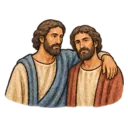
This imagined Corinthian courtyard illustrates Paul's question about accepting wrong or material loss rather than suing one another. The pouch, coins and restrained gestures suggest a dispute and a choice not to press it. These men and this encounter are illustrative, not a recorded event; the verse does not say the wrong itself is good.
This imagined withheld-payment encounter illustrates wronging and defrauding a fellow believer. The guarded pouch, coins and unanswered empty palm make the breach of trust visible. The verse names no particular transaction, courtyard or individuals; these details are illustrative, and the men are not historical likenesses.
The barred gateway imaginatively conveys the warning that the unrighteous will not inherit God's kingdom, while the fallen clay idol recalls the verse's explicit mention of idolatry. The garden suggests the preciousness of that inheritance. This is an object-and-setting meditation, not an event described by Paul or a literal depiction of heaven. The sexual categories remain in the explanation rather than being represented through acts or stereotypes. Artwork remains pending human review.
This imaginative courtyard groups the verse's named wrongs through a concealed purse, guarded coins, spilled wine, an angry gesture and a merchant's scale. The closed garden gate evokes exclusion from God's kingdom; it is a visual metaphor, not a description of heaven or a recorded biblical event. The figures are unnamed, and no divine person is portrayed.
This imaginative courtyard gathering suggests cleansing and renewed fellowship through clear water, clean linen and grateful faces. The verse declares washing, sanctification and justification in Jesus Christ’s name and by God’s Spirit; it does not narrate this gathering or say that washing with ordinary water earns salvation. The people and setting are artistic conventions, and God is not pictured.
This imaginative courtyard scene illustrates choosing what benefits rather than simply taking what is available. The man attends to a living olive tree while setting aside his cup. The tree, meal and man are artistic examples, not objects or an event named in the verse. The scene does not imply that food or drink is inherently forbidden; it points toward refusing to be mastered by anything.
This imaginative courtyard scene uses an ordinary meal to recall food and the belly, while the modestly clothed woman praying suggests the body devoted to the Lord. The verse does not narrate this event. Sexual immorality remains offstage; the image does not literally depict God bringing food and belly to an end, and ordinary sunlight does not represent God.
This imaginative garden composition connects the empty tomb, recalling the Lord's accomplished resurrection, with anonymous believers looking toward the dawn in hope of their promised future resurrection through God's power. The verse does not narrate this gathering or specify these tomb details. The adults are not identified witnesses, and neither God nor Jesus is portrayed.
This imagined courtyard scene illustrates the verse's emphatic refusal through a man's bodily turn and raised palm. The empty shadowed doorway indirectly suggests the rejected union with a prostitute; the fellowship suggests belonging to Christ. Neither setting nor action is a narrated event in the verse, and no person depicts Christ. The image cannot literally show membership in Christ's body.
The two thread colors woven into one cloth imaginatively echo the verse's two becoming one flesh. The loom and courtyard are teaching imagery, not objects or an event stated in the verse. This quiet composition avoids depicting sexual activity; its beauty does not approve the union with a prostitute that Paul warns about.
The unnamed believer praying expresses communion with the Lord imaginatively. The verse teaches spiritual union; it does not describe this woman or courtyard. Natural morning light lends warmth without depicting God or making the invisible spirit a visible object. Human artwork review remains pending.
This imaginative scene pictures the command to flee sexual immorality through a man decisively leaving a shadowed doorway. The doorway is an indirect cue for temptation, not a biblical location or an accusation against its inhabitants. His clothed body is treated with dignity. The scene does not depict a recorded event or fully illustrate the verse's contrast between other sins and sin against one's own body.
This imaginative prayer scene suggests reverent care for the body and surrender to God, relating to the teaching that believers are temples of the Holy Spirit and are not their own. The verse does not narrate this man or courtyard. The sunlight is natural light, not a depiction of the Spirit; no literal temple or divine figure is shown.
These anonymous worshippers are an imaginative illustration of glorifying God bodily, not an event narrated in the verse. Their prayerful postures suggest grateful dedication, while the distant empty cross recalls the cost of redemption. The verse commands bodily honor to God beyond the act of prayer; it does not describe this courtyard or name these people.