This imaginative race illustrates the call to persevere. The discarded pack and cloak picture hindrances; the tangled rope pictures entangling sin, without making those objects sinful. The surrounding multitude evokes the cloud of witnesses and their testimony. It is not a recorded race or a claim that departed people literally watch believers. All runners are ordinary people.
This imaginative landscape invites attention to the cross Jesus endured. Warm dawn light and small living flowers suggest the joy set before Him without diminishing the shame and suffering He bore. The bare cross is an indirect meditation, not a reconstruction of the crucifixion. Jesus and God are not pictured; His place at the right hand of God is stated in the verse rather than depicted.
This imaginative courtyard meditation illustrates believers taking heart as they consider Jesus enduring hostility. The distant argument suggests opposition; the empty cross recalls his endurance without depicting him. The people, courtyard and hill are artistic inventions, not an event or location specified in Hebrews 12:3.
This is an imaginative analogy, not a narrated event: the travelers pressing against wind picture persevering resistance in the struggle against sin. Their unwounded bodies accord with the statement that the readers have not yet resisted to bloodshed. The landscape is not sin personified, and the picture cannot show the full moral struggle described by the verse.
This imaginative earthly father-and-son carpentry lesson illustrates receiving correction seriously without losing heart. It is an analogy, not an event narrated in Hebrews or a human portrayal of God. The father's pointing hand and reassuring touch, and the son's attentive posture and ready mallet, relate discipline to continued effort.
This imaginative household scene is not an event narrated in the verse. The resting scourge acknowledges its explicit language of painful correction, while the open home and prepared table suggest received sonship. The adult man represents a son under discipline; he does not portray God or Jesus. God remains unseen.
This imagined human father and son illustrate the verse's comparison: patient correction calls for endurance within a father-child relationship. The demanding woodworking lesson is an artistic analogy, not an event reported in Hebrews. The father is an ordinary human parent, not a portrayal of God.
This imaginative earthly household lesson illustrates discipline as training shared by sons. The empty stool and untouched wood suggest absence from that shared training, echoing the verse's warning about illegitimacy rather than sonship. The courtyard and woodworking are artistic analogies, not a reported biblical event; the father does not portray God.
This imaginative domestic scene illustrates the verse's earthly comparison: a child respectfully receiving his father's correction. It is not a recorded biblical event. The greater call is submission to the Father of spirits and life; God is left unpictured, and the garden is ordinary scenery rather than a representation of Him.
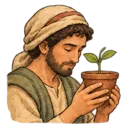
This imagined garden lesson uses the supported sapling as an analogy for purposeful correction and growth. The father is an ordinary earthly parent, not God. The verse contrasts limited human judgment with God's discipline for our good, whose purpose is sharing His holiness; it does not narrate this gardening scene.
This imaginative orchard is an analogy, not an event narrated in Hebrews. The weary gardener and carefully trained sapling suggest discipline that feels sorrowful now; the mature tree and gathered figs suggest its later peaceful yield. The literal fruit illustrates righteousness without equating righteousness with material abundance.
These anonymous travelers are an imaginative illustration, not a recorded event. The older man lifting his arms and beginning to stand gives visible form to the command to raise drooping hands and strengthen weakened knees. His companion suggests encouragement in perseverance; the scene does not claim a miraculous cure or portray Jesus.
This imaginative scene gives visible form to the verse’s straight-path imagery: a companion removes a stumbling stone while another supports a weakened traveler. The clear way suggests a steady course that protects what is lame and seeks healing. It depicts no recorded incident or instantaneous cure; the anonymous people and setting are illustrative.
This imagined reconciliation illustrates actively pursuing peace with others. The continuing uphill path suggests persevering in a life devoted to holiness, not a literal route to seeing the Lord. The Lord remains unseen. The scene is not a narrated biblical event, and clean garments do not define holiness; the verse states that without holiness no one will see the Lord.
This imaginative garden illustrates the verse’s warning, not a recorded event. The spreading root beside several withering plants pictures bitterness troubling and defiling many. The gardeners’ attention and the women’s caring gesture suggest mutual watchfulness so no one falls short of God’s grace. The garden does not portray grace as something earned by human work; the people and setting are imaginative.
This imaginative portrayal focuses on Esau receiving the one meal for which the verse says he sold his birthright. His absorption in the food evokes immediate appetite overshadowing a precious privilege. The birthright itself is not pictured as an invented object. The pastoral setting and appearance are artistic conventions; the separate warning against sexual immorality is not staged.
The solitary man, tears and empty outstretched palm imaginatively express the earnest longing and loss described in the verse. The tent and landscape are artistic setting choices, not details stated here. No divine refusal is pictured, and the composition does not settle whether the final pronoun refers to repentance or the blessing.
This imaginative landscape evokes the tangible Sinai setting recalled by the fire, darkness, gloom and storm. The mountain supplies contextual scenery rather than a noun explicitly present in this Greek verse. No arriving people are shown: the verse says the readers have not come to this scene. It is an illustration, not a reconstruction of the mountain or a portrayal of God.
This imaginative Sinai setting connects the hearers' pleading gestures and covered ear with their request to hear no further word. The mountain and cloud evoke the remembered encounter; the trumpet and speaking voice remain unseen. The painting does not portray God or claim historical likenesses.
The people standing back and the goat near the mountain imaginatively evoke the command they could not bear. The goat illustrates the conditional warning, not an animal the verse says was actually killed. Scattered stones quietly recall the prescribed stoning without depicting the act. The setting and people are imaginative conventions.
Moses' tense posture and drawn-in hands imaginatively express his words about being greatly afraid and trembling. The immense mountain, dark clouds and fiery light evoke Sinai's fearful sight; those setting details are contextual artistic choices rather than details itemized in this verse. No divine figure is portrayed. His appearance is imaginative, not a historical likeness. Artwork remains pending human review.
The imagined city on a rising mountain joins Mount Zion with heavenly Jerusalem; the many robed angels evoke the verse's myriads in festal assembly. The open approach suggests the hearers' access without claiming an earthly journey. Architecture, wings, flowers and gestures are artistic conventions, not details specified by the verse. God is not depicted. Artwork remains pending human review.
This imaginative heavenly gathering evokes the assembly of the firstborn, while the blank scroll suggests their enrollment without inventing names. Distant figures suggest the righteous made perfect without claiming to show the appearance of spirits. The assembly faces light beyond the scene in reverence toward God, Judge of all; God is not pictured. The architecture, scroll and clothing are illustrative choices, not details supplied by the verse. Human artwork review remains pending.
This imaginative still life evokes the new covenant through an unlettered scroll and the blood of sprinkling through a basin and restrained droplets. The open path suggests approach through Jesus the mediator. It is not a reconstruction of a ceremony. Jesus and Abel remain unseen; the verse itself supplies the comparison that His blood speaks better than Abel.
This imaginative teaching scene contrasts attentive listening with turning away. The open, illuminated sky suggests the heavenly direction of the address without portraying God. It does not reconstruct a recorded event or depict the earlier earthly warning; that comparison and the warning of inescapable accountability belong to the verse itself.
This imaginative landscape pairs trembling, fissured earth with a vast stirred sky to evoke the promised shaking of both earth and heaven. It does not claim to show the precise event or its timing. The golden horizon expresses reverent hope; it is atmospheric light, not a portrayal of God. No speaker or eyewitness is invented.
This imaginative landscape contrasts masonry falling away with an undisturbed central rock, illustrating removal so that the unshaken remain. The verse does not describe this landscape or a particular earthquake; the rock is a visual analogy, not a claim that created stone is eternal. No divine figure is depicted. Artwork remains pending human review.
This imaginative gathering expresses grateful, reverent service to God. The city resting on solid rock is a visual analogy for the unshakable kingdom, not a literal description of its architecture or a recorded event. The worshippers are unnamed; God is not depicted.
This imaginative wilderness fire makes the verse's consuming-fire comparison visible through burning branches, embers and ash. It is not a portrait of God or a narrated biblical event. Its beauty and formidable heat invite reverence without reducing the declaration to comforting warmth. Artwork remains pending human review.
 ὄγκον Weight to be laid aside
 εὐπερίστατον Easily entangling, describing sin in Hebrews 12:1.
 νέφος a cloud