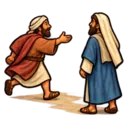
An imaginative portrayal of John 4:1, in which Jesus learns that the Pharisees have heard he is making and baptizing more disciples than John. The setting and conversations are imagined; the disciple performing the baptism reflects the clarification in John 4:2.
An imaginative riverside scene illustrating John 4:2: Jesus himself did not baptize; his disciples did. The setting and the participants' appearances are imagined. The chapter identifies its English word glosses as Berean Interlinear.
An imaginative depiction of Jesus' journey: John 4:3 says he left Judea and went again into Galilee. The setting and details are artistic interpretation. The English word glosses are from the Berean Interlinear Bible.
An imaginative depiction of Jesus passing through Samaria in John 4:4. The landscape and visual details are artistic interpretation. The verse's English word glosses are from the Berean Interlinear Bible.
An imaginative depiction of John 4:5: Jesus comes to Sychar in Samaria near the plot of ground Jacob gave his son Joseph. The town and landscape are artistic interpretations. The English word glosses are from the Berean Interlinear Bible.
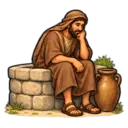
This imaginative scene reflects John 4:6: Jesus, weary from his journey, sits at Jacob's well about the sixth hour. His appearance and the well and landscape are artistic interpretation. The scene follows the verse and its Berean Interlinear token glosses.
An imaginative depiction of John 4:7, where a woman from Samaria comes to draw water and Jesus asks her for a drink. The source's English word glosses are from the Berean Interlinear Bible.
An imaginative depiction of Jesus' disciples in the city to buy food, as John 4:8 describes. The market, people, and exchange are artistic details; the verse's token glosses are from the Berean Interlinear Bible.
An imaginative depiction of John 4:9: the Samaritan woman questions Jesus about his request for a drink, and the verse notes that Jews did not associate with Samaritans. The setting and gestures are artistic choices.
An imaginative portrayal of John 4:10, where Jesus speaks of the gift of God and says that the woman would have asked him and he would have given her living water. The visible water and setting are artistic choices. The source verse's English token glosses are Berean Interlinear glosses marked uncurated, not GBT-approved.
An imagined moment inspired by John 4:11: the woman asks Jesus where He has living water when He has nothing to draw with and the well is deep. The word glosses used to guide the scene are from the Berean Interlinear Bible, as identified in the reader's source note.
An imaginative portrayal of the Samaritan woman asking Jesus whether he is greater than Jacob, who gave the well and from which he, his sons, and his livestock drank. The animals evoke her reference; the verse does not say they were present during the conversation.
An imaginative depiction of Jesus speaking with the Samaritan woman at the well as he says that everyone who drinks this water will thirst again. The setting and visual details are artistic interpretation; the token glosses come from the Berean Interlinear.
This imaginative scene visualizes Jesus' promise that the water he gives becomes a spring within the recipient, welling up to eternal life. The visible spring and flowers are an artistic metaphor, not a visible event described in the verse.
This imaginative scene illustrates the woman asking Jesus for water so that she will not thirst or need to come here to draw, in John 4:15. The appearance, gestures, and landscape are artistic interpretation. The English token glosses are from the Berean Interlinear Bible.
This imaginative scene depicts the conversation at the well as Jesus tells the woman to go, call her husband, and come here, following the verse's Berean Interlinear token glosses.
An imaginative depiction of John 4:17, where the woman answers that she has no husband and Jesus says she has spoken correctly. The setting, expressions, and gestures are artistic choices; the verse relationship follows the Berean Interlinear token glosses.
This imaginative scene evokes Jesus' conversation with the Samaritan woman in John 4:18, where he acknowledges that she has spoken truthfully and speaks of her five past husbands and the man who is not her husband now. The pebbles are an artistic addition suggesting those relationships.
An imaginative scene of John 4:19, in which the woman tells Jesus she understands him to be a prophet. The well comes from the surrounding passage; the lesson identifies its English token glosses as Berean Interlinear Bible.
This imaginative scene depicts the conversation in John 4:20, where the woman contrasts her ancestors' worship on the mountain with the claim that Jerusalem is the place to worship. The English word glosses are from the Berean Interlinear Bible, not a GBT approval.
This imaginative scene portrays Jesus speaking with the Samaritan woman as he tells her that a time is coming when worship of the Father will be neither on this mountain nor in Jerusalem. The setting and gestures are artistic choices.
An imaginative scene of Jesus speaking with the Samaritan woman at Jacob's well. In John 4:22 he contrasts worship of what is not known with worship of what is known and says that salvation is from the Jews. The chapter's word glosses are from the Berean Interlinear Bible.
This imaginative scene shows Jesus speaking with the Samaritan woman at the well. The distant worshipers are an artistic addition illustrating John 4:23, where Jesus speaks of true worshipers worshiping the Father in spirit and truth and says that the Father seeks such worshipers.
This imaginative scene places Jesus and the Samaritan woman at the well as he teaches that God is Spirit and that worship must be in spirit and truth. The gestures and setting interpret the teaching rather than depicting details stated in this verse. The chapter's English token glosses are from the Berean Interlinear Bible.
An imaginative depiction of John 4:25, where the woman speaks of the coming Messiah, called Christ, who will tell them all things. The appearance and details of the scene are imagined.
An imaginative depiction of John 4:26 and its setting at Jacob's well: Jesus speaks to the Samaritan woman after she mentions the coming Messiah. The source identifies the English word glosses as Berean Interlinear.
An imaginative depiction of John 4:27: Jesus speaks with the Samaritan woman at Jacob's well as his disciples arrive, amazed but not voicing the questions mentioned in the verse. The scene is informed by the Berean Interlinear token glosses; the appearances and setting details are imagined.
An imaginative illustration of John 4:28: the woman leaves her water pot, goes into the city, and speaks to the men. The setting, appearance, and gestures are artistic interpretation. The word glosses come from the Berean Interlinear Bible and are not a Global Bible Tools approval.
This imaginative scene shows the Samaritan woman inviting the townspeople to see the man who told her what she had done and asking whether he could be the Christ, as in John 4:29. The appearances, setting, and gestures are imagined. The English word glosses are from the Berean Interlinear Bible.
An imaginative scene of the disciples asking Jesus, their Rabbi, to eat in John 4:31. The bread, gestures and visual details are imagined; the well follows the surrounding passage. The English word glosses are from the Berean Interlinear Bible.
This imagined scene depicts Jesus telling his disciples that he has food to eat which they do not know, as reflected in the Berean Interlinear token glosses. The offered bread evokes their earlier invitation to eat; the food he speaks of is left unpictured.
An imaginative rendering of John 4:33, where the disciples ask one another whether someone brought Jesus anything to eat. The well comes from the surrounding passage; the figures' appearances and gestures are imagined. The English token glosses are from the Berean Interlinear Bible.
This imaginative scene evokes John 4:34, where Jesus describes His food as doing the will of the One who sent Him and finishing His work. The bread and approaching villagers suggest the surrounding story; their appearance and arrangement are imagined. The chapter's English word glosses are from the Berean Interlinear Bible.
This imaginative scene draws on John 4:35 and its Berean Interlinear token glosses: Jesus asks his listeners to lift their eyes and see fields already white for harvest. The setting and figures are an artistic interpretation.
This imaginative scene echoes the harvest metaphor in John 4:36: the sower and reaper rejoice together, while the reaper gathers the harvest and a small pouch suggests the reward. The abundant field and warm light allude to fruit for eternal life.
An imaginative scene inspired by John 4:39, where many Samaritans believe in Jesus because of the woman's testimony that he told her all she had done. The setting and gestures are artistic interpretation. The verse's English token glosses are from the Berean Interlinear Bible, not a GBT approval.
An imaginative welcome illustrates the Samaritans asking Jesus to stay with them in John 4:40. The verse says he stayed there two days; this single scene does not depict the duration.
This imaginative scene pictures Samaritan villagers hearing Jesus in the setting of John 4:41, where many more believed because of his word; the English token glosses are from the Berean Interlinear Bible.
This imaginative scene illustrates John 4:42, where the Samaritans tell the woman that they have heard for themselves and know Jesus is truly the Savior of the world. The chapter's English word glosses are from the Berean Interlinear.
John 4:43 says that after two days he departed from there for Galilee; the preceding passage places him among the Samaritans. This scene imagines the village, figures, and journey.
This imaginative scene illustrates Jesus’ testimony that a prophet has no honor in his own hometown. The setting, companions, and townspeople’s actions are artistic interpretations, not details stated in John 4:44.
This imagined welcome in Galilee illustrates John 4:45: the Galileans received Jesus after seeing what he had done in Jerusalem during the feast, which they themselves had attended. The meeting and its setting are artistic interpretation.
This imaginative scene pictures the royal official and his sick son in Capernaum mentioned in John 4:46. The verse also says Jesus returned to Cana of Galilee, where he had made water into wine.
An imaginative depiction of John 4:47: a royal official asks Jesus to come down and heal his son, who is near death. The setting and gestures are imagined; the son is not shown.
This imaginative scene depicts Jesus speaking to the royal official in John 4:48 about seeing signs and wonders and believing. The listeners, setting, and appearances are imagined. The source's English word glosses are from the Berean Interlinear Bible, keyed to the Nestle 1904 Greek text by biblicalhumanities.org; they are not a GBT approval.
This imaginative scene reflects John 4:49, in which the royal official asks Jesus to come down before his child dies. The setting, appearances, and gestures are artistic choices. The chapter's English word glosses are from the Berean Interlinear and are not a Global Bible Tools approval.
This imaginative scene depicts John 4:50: Jesus tells the man to go because his son lives; the man believes Jesus' word and goes on his way. The English token glosses are from the Berean Interlinear Bible.
An imagined meeting based on John 4:51 and the Berean Interlinear word glosses: as the father goes down, his servants meet him with the news that his boy lives. The setting, clothing, and expressions are artistic details.
This imagined scene shows the father asking his servants when his son began to get better. In John 4:52, they answer that the fever left him yesterday at the seventh hour. The landscape and gestures are artistic choices.
This imaginative scene reflects John 4:53: the father recognized that the hour matched Jesus' words that his son lived, and he and his whole household believed. The home, gathering, gestures, and appearances are artistic choices. The English token glosses come from the Berean Interlinear and are not a Global Bible Tools approval.
This imaginative scene recalls Jesus reassuring the royal official in Cana. John 4:54 identifies the healing of the official's son at a distance as Jesus' second sign after coming from Judea to Galilee.