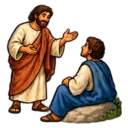
This imaginative scene pictures Jesus going across the Sea of Galilee, also called the Sea of Tiberias, in John 6:1. The boat, shoreline, and weather are artistic choices; the verse does not describe them.
An imaginative illustration of John 6:2: a large crowd followed Jesus because they were seeing the signs he was doing on those who were sick. The individual encounter and setting are artistic choices; the word glosses used are from the Berean Interlinear.
An imaginative depiction of John 6:3, in which Jesus goes up the mountain and sits there with his disciples; the landscape and figures are artistic interpretation.
The chapter's uncurated Berean Interlinear glosses describe Passover, the feast of the Jews, as near. This imagined household and its preparations evoke the approaching feast; the verse does not describe them.
This imaginative scene depicts Jesus speaking to test Philip, while already knowing what he was about to do. The approaching crowd and question about bread come from the preceding verse.
This imaginative scene shows Philip explaining that even two hundred denarii worth of bread would not give each person in the crowd a little. The loaf and purse are visual additions, not details stated in John 6:7. The source word glosses are from the Berean Interlinear Bible.
An imaginative scene of Andrew, whom John 6:8 identifies as Simon Peter's brother, speaking to Jesus. The appearances and visual details are imagined. The chapter file attributes its English token glosses to the Berean Interlinear Bible; they are not a GBT approval.
This imaginative scene depicts the little boy with five barley loaves and two small fish in John 6:9; the crowd suggests the question of what these are for so many. The English token glosses are from the Berean Interlinear Bible.
An imaginative scene inspired by John 6:10: Jesus asks for the people to recline in a place with much grass, and about five thousand men recline. The setting, appearances, and arrangement are imagined. The chapter's English token glosses are from the Berean Interlinear Bible; they are uncurated and are not GBT approval.
An imaginative rendering of John 6:11: after giving thanks, Jesus distributes the loaves and likewise fish to those reclining, as much as they wished. The setting and visual details are artistic interpretation. The chapter identifies the English word glosses as Berean Interlinear glosses.
An imaginative view of John 6:12, when Jesus tells his disciples to gather the remaining fragments after the people have eaten their fill, so that nothing is lost. The setting and visual details are artistic choices.
An imaginative scene of John 6:13: twelve baskets are filled with fragments left from the five barley loaves after people had eaten. The verse relationship follows the chapter's Berean Interlinear glosses.
This imaginative scene interprets John 6:14, when people speak of Jesus as the prophet after seeing the sign he performed. The baskets of bread fragments recall the feeding and gathering described in John 6:11-13. The English token glosses in the source are from the Berean Interlinear Bible.
An imaginative depiction of Jesus withdrawing to the mountain alone after realizing that the people intended to seize him and make him king. The crown and landscape are artistic details.
An imaginative depiction of John 6:16, in which Jesus' disciples go down to the sea as evening comes. The landscape, figures, and boats are artistic interpretation.
An imaginative illustration of John 6:17: the disciples cross the sea toward Capernaum after dark, before Jesus has come to them. The moon, distant lights, and details of the boat are artistic choices. The verse's English word glosses are from the Berean Interlinear Bible.
John 6:18 describes the sea becoming agitated as a strong wind blows. This imaginative scene places the disciples' boat from the preceding passage amid the waves; the visual details are imagined.
An imaginative depiction of John 6:19: after rowing about twenty-five or thirty stadia, the disciples see Jesus walking on the sea and coming near their boat, and they are frightened. Their appearance, the boat, and the moonlit setting are artistic choices. The scene is informed by the verse's Berean Interlinear word glosses.
An imaginative depiction of John 6:20, when Jesus reassures the disciples and tells them not to fear. John 6:18–19 supplies the setting of the wind, sea and boat. The chapter identifies its English token glosses as Berean Interlinear, not GBT-approved.
An imaginative scene guided by the chapter's Berean Interlinear token glosses: the disciples are willing to receive Jesus into the boat, and the boat is at the land toward which they were going. The night and rough water recall the preceding verses; the figures and moonlit shore are imagined.
An imaginative view of the crowd on the next day as they consider the one boat and realize that the disciples had departed without Jesus. The distant boat's position and the crowd's gestures are artistic details.
This imaginative scene depicts boats from Tiberias arriving near the place where people had eaten bread after the Lord gave thanks; the basket evokes that earlier meal.
An imaginative rendering of John 6:24, in which the crowd travels by boat to Capernaum seeking Jesus after finding neither him nor his disciples. The appearance of the people and setting is artistic interpretation. The verse's English token glosses are from the Berean Interlinear Bible.
An imaginative portrayal of John 6:25, where the crowd finds Jesus on the other side of the sea and asks when He came there. The lakeshore setting, gestures, and appearances are artistic details. The chapter's English word glosses are from the Berean Interlinear Bible, not GBT-approved glosses.
This imaginative scene illustrates John 6:26, where Jesus says the people seek him because they ate the loaves and were satisfied rather than because they saw signs. The setting and visual details are artistic choices. The verse's English token glosses come from the Berean Interlinear; they are not a GBT approval.
This imaginative scene for John 6:27 uses the offered loaf and aging food to suggest the contrast between perishable food and the enduring food the Son of Man gives for eternal life. The light on Jesus suggests the Father's seal on him. These are visual metaphors, not a literal account. The word glosses are the uncurated Berean Interlinear glosses associated with the Nestle 1904 text, not GBT-approved glosses.
An imaginative depiction of the question in John 6:28: the people ask Jesus what they should do to carry out the works of God. The setting and gestures are artistic choices, not details stated in the verse. The wording follows the verse's Berean Interlinear word glosses.
This imaginative scene evokes John 6:29, where Jesus answers that the work of God is to believe in the one God sent. The lakeside setting and people's appearances are artistic choices. The English token glosses are from the Berean Interlinear, not a GBT approval.
An imaginative depiction of John 6:30, where people ask Jesus what sign and work he will perform so they may see and believe him. The setting, poses, and appearances are artistic choices.
This imaginative scene pictures the ancestors' wilderness meal recalled in John 6:31, where the speakers say they ate manna and quote that bread from heaven was given to them.
An imaginative portrayal of Jesus' words in John 6:32: his Father gives the true bread from heaven, in contrast to Moses. The lakeside setting, gestures, and basket of bread are artistic interpretation, not details stated in this verse.
This imaginative scene uses Jesus offering bread and light descending from the sky to evoke John 6:33: the bread of God is the One coming down from heaven and giving life to the world. It is not a depiction of a specific event described in the verse. The English word glosses are from the Berean Interlinear Bible.
An imaginative depiction of the people asking Jesus to give them this bread always in John 6:34. The setting and loaf are artistic choices; the verse does not describe them. The English token glosses come from the file's uncurated Berean Interlinear layer.
This imaginative scene illustrates Jesus' words that he is the bread of life: the one who comes to him will not hunger, and the one who believes in him will not thirst. The bread and water vessel are visual reminders; the setting and objects are imagined.
This imaginative scene reflects John 6:36, where Jesus says His listeners have seen Him and yet do not believe. The courtyard and the listeners’ expressions are artistic choices, informed by the verse’s uncurated Berean Interlinear glosses.
This imaginative scene shows Jesus welcoming someone who comes to him, reflecting his promise that all the Father gives him will come and that he will never cast out the one who comes. The English word glosses consulted are the uncurated Berean Interlinear glosses.
This imaginative scene evokes John 6:38, where Jesus says he came down from heaven to do the will of the One who sent him. The setting, listeners, and gesture are artistic choices. The source file's English word glosses are from the Berean Interlinear.
An imaginative visual meditation on John 6:39: Jesus preserves all that the One who sent him has given him and raises it on the last day. The figures and setting are artistic interpretation. The chapter's English word glosses are from the Berean Interlinear, not a GBT-approved translation.
An imaginative picture of the Father's will that those who behold and believe in the Son have eternal life, and of Jesus' promise to raise them on the last day.
This imagined gathering portrays the listeners grumbling about Jesus as he speaks. The loaf is a visual reminder of his statement that he is the bread that came down from heaven, not an additional action described in the verse.
An imagined conversation illustrates John 6:42: people question how Jesus, whom they identify as Joseph's son and whose father and mother they know, can say that he came down from heaven. The courtyard, gestures and sunlight are artistic choices, not details specified by the verse.
An imaginative depiction of Jesus answering the people and telling them not to grumble among one another in John 6:43. The setting and visual details are artistic choices; the source's English word glosses are from the Berean Interlinear Bible.
An imaginative visual metaphor for John 6:44: heavenly light suggests the Father drawing a person to Jesus, and rising beside the tomb suggests Jesus’ promise to raise that person on the last day. This is not a claim that the pictured event was witnessed.
This imaginative scene evokes John 6:45: those who hear and learn from the Father come to Jesus. The sunlight and scroll are visual symbols, not details the verse describes.
An imaginative depiction of Jesus teaching about the Father. John 6:46 says that no one has seen the Father except the One who is from God; the Father is not depicted.
This imaginative scene evokes John 6:47's assurance that the one believing has eternal life. The sunlit olive tree suggests life; it is not a detail stated in the verse. The verse's English word glosses come from the Berean Interlinear Bible.
This imaginative scene uses a loaf as a visual reminder of Jesus' declaration that he is the bread of life. The particular courtyard, loaf, and listeners are artistic additions, not details specified in John 6:48.
This imaginative scene reflects John 6:49's words that the fathers ate manna in the wilderness and died. The stone mound suggests mortality without implying that the manna caused their deaths.
This imaginative scene uses Jesus offering bread and light descending from the sky to evoke His words about the bread coming down from heaven, which one may eat and not die. The setting and gathering are artistic interpretation.
This imaginative scene uses bread, descending light, and Jesus' gesture to evoke John 6:51: he is the living bread from heaven and will give his flesh for the life of the world. The verse does not describe this particular gathering or action.
An imaginative depiction of the listeners arguing over how Jesus could give them flesh to eat, as reflected in the Berean Interlinear word glosses for John 6:52. The setting and gestures are artistic interpretations.
An imaginative scene for John 6:53: Jesus teaches while bread and a cup evoke his words that unless people eat the Son of Man's flesh and drink his blood, they have no life in themselves. The setting and objects are imagined.
This imaginative scene uses bread and a cup to evoke Jesus' words about eating his flesh and drinking his blood. Jesus helping the man rise evokes his promise of eternal life and of raising that person on the last day in John 6:54.
This imaginative scene uses bread and a cup to evoke Jesus' words in John 6:55: his flesh is true food and his blood is true drink. The verse itself does not describe this particular gathering.
This imagined meal uses bread and a cup to evoke Jesus' words about eating his flesh and drinking his blood, while the closeness of Jesus and the disciple suggests his promise of mutual abiding. The verse does not describe this particular meal.
This imaginative scene uses bread and sunlight to evoke John 6:57: Jesus says the living Father sent him and he lives because of the Father, and the one feeding on him will live because of him. The setting and gestures are artistic choices. The chapter's English word glosses are from the Berean Interlinear and are not a Global Bible Tools approval.
This imaginative scene uses the loaf, sunlight, living tree, and distant tombs to evoke Jesus's contrast in John 6:58: the fathers ate and died, while the one who eats this bread will live into the age. The scene is a visual interpretation, not a recorded description of this moment.
This imaginative scene depicts the disciples' response in John 6:60: after hearing Jesus, many describe the word as difficult and ask who can hear it. The synagogue at Capernaum follows the setting in John 6:59. The local English word glosses are from the Berean Interlinear, not a Global Bible Tools approval.
An imaginative depiction of John 6:61: knowing His disciples are grumbling about His teaching, Jesus asks whether it offends them. The setting and appearances are artistic choices. The English word glosses are from the Berean Interlinear Bible.
An imaginative visualization of Jesus' question in John 6:62 about seeing the Son of Man ascend to where he was before, not a claim that this scene occurred at that moment. The English word glosses are from the Berean Interlinear Bible.
An imagined teaching scene inspired by John 6:63. The listeners and fresh greenery evoke Jesus' words that the Spirit gives life and that the words he has spoken are spirit and life. The verse's contrast with flesh that profits nothing is not depicted literally. The English word glosses used as guidance are from the uncurated Berean Interlinear, not a GBT approval.
An imaginative scene inspired by John 6:64, where Jesus knows from the beginning who does not believe and who will betray him. The setting, gestures, and expressions are artistic interpretation. The source's English word glosses are from the Berean Interlinear, not a GBT approval.
This imaginative scene for John 6:65 uses the light to suggest the Father's granting of a person's coming to Jesus as Jesus teaches his listeners. The verse's English word glosses are from the Berean Interlinear Bible.
This imaginative scene illustrates John 6:66, where many of Jesus' disciples went back and no longer walked with Him. The setting, people, and gestures are artistic interpretation.
This imagined scene depicts Jesus asking the Twelve whether they also wish to go away in John 6:67. The courtyard, gestures, and landscape are artistic choices.
This imaginative scene depicts John 6:68, where Peter asks to whom they would go and says Jesus has the words of eternal life. The setting and gestures are imagined; the departing figures evoke the preceding verses. English word glosses are from the Berean Interlinear Bible.
An imaginative portrayal of Peter speaking for the disciples as they confess that they have believed and known Jesus to be the Holy One of God in John 6:69. The lakeside setting and appearances are artistic choices.
This imagined gathering illustrates Jesus asking the Twelve whether he chose them and saying that one of them is a devil. The setting and shadow are artistic details, and the scene does not identify an individual.
An imaginative scene of Jesus speaking with disciples, with Judas set apart in quiet reflection. The verse identifies Judas, son of Simon Iscariot, as one of the Twelve who was about to betray him; the illustration does not show all twelve disciples.
 Tiberias, in the sea’s alternate name
 the sea, specifically the Sea of Galilee or Tiberias