The imagined viewpoint shows Jesus only through His bound hands, connecting the verse's binding and delivery to Pilate. A representative group stands for the council's involvement; the courtyard, clothing, gestures and exact arrangement are artistic reconstruction, not details supplied by the verse. The warm dawn light reflects its early-morning timing. Human artwork review remains pending.
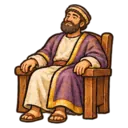
The seated governor's open hand and attentive expression imagine Pilate's question about Jesus' kingship. Jesus remains outside the frame, so His answer is conveyed by the verse rather than illustrated as written words. The face, dress and court are artistic reconstructions, not a historical likeness or archaeological certainty.
The four men imaginatively represent the chief priests bringing many accusations. Their speaking faces and gestures convey the continuing action, directed toward Jesus beyond the right edge without portraying Him. Their number, clothing and courtyard are illustrative choices, not details specified by the verse; no particular charge is invented.
Pilate's open palm and the nearby accusers' gestures imaginatively stage his renewed question to Jesus about the many charges. Jesus remains outside the frame. The courtyard, appearances, and clothing are artistic conventions rather than historical likenesses or archaeological certainty.
This imaginative hearing scene focuses on Pilate marveling when Jesus gives no further answer. His paused open hand and astonished expression suggest the unanswered moment; Jesus remains outside the picture. The clothing, architecture, chair, and pose are artistic conventions, not details specified by this verse or claims of historical likeness.
An unnamed prisoner leaving an open gate, a guard holding the loosened binding, and a petitioning gathering imaginatively illustrate the feast-time custom of releasing one prisoner requested by the people. The official appears only through his hand and robes. The prisoner is unnamed; the setting, clothing and faces are imaginative conventions. Jesus is outside the picture.
Barabbas is imagined as the central chained prisoner, with two fellow insurgents behind him. Their confinement illustrates the verse; the murder during the insurrection has already occurred and is not shown. Faces, clothing, prisoner count, and prison architecture are imaginative details, not historical likenesses or archaeological claims.
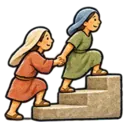
The crowd's open palms and speaking faces visualize the beginning of its customary request. The rising steps suggest its coming up. The civic entrance, clothing and individual faces are imaginative details, not historical likenesses or certain architecture. The recipient remains unseen, and no decision or release is depicted.
Pilate's open palm and the attentive listeners imagine the question in Mark 15:9 about releasing the King of the Jews. Jesus remains outside the frame. The courtyard, clothing, faces, and Roman guard are imaginative setting details, not details specified by this verse or claims of historical likeness. The scene depicts neither an actual release nor the people's later answer.
Pilate's attentive gaze toward the gathered chief priests imaginatively relates his awareness of their envy. Their guarded expressions suggest the verse's stated motive without making inward knowledge literally visible. Jesus remains outside the frame. The poses, costumes, and courtyard are artistic conventions, not documented details.
The two speakers imaginatively represent the chief priests stirring the crowd to request Barabbas's release. Their gestures and the listeners' raised hands suggest persuasion and growing agitation. Jesus, Barabbas and the governor remain outside the frame; no release is depicted. Faces, clothing and the courtyard are imaginative conventions, not historical likenesses.
Pilate's open hand and the gathering's attentive faces visualize his renewed question. Jesus remains outside the frame. The clothing, magistrate's chair, courtyard, faces, and arrangement are imaginative conventions, not historical likenesses or certain archaeological details; the verse does not specify them. No later reply or punishment is shown.
Open mouths and insistent gestures imagine the repeated demand, "Crucify him." Jesus remains outside the frame, so the image depicts the crowd's cry rather than the execution. The courtyard, faces, and clothing are imaginative details, not historical likenesses.
An imaginative Roman courtyard places Pilate's questioning gesture opposite the crowd's increasingly forceful cries for Jesus' crucifixion. Jesus remains outside the frame; no execution is shown. Faces, clothing and architecture are artistic conventions, not established likenesses or archaeological certainties.
This imaginative courtyard scene focuses on Pilate releasing Barabbas to satisfy the crowd. The open fetter makes release visible, while the resting scourge recalls the flogging named in the verse. Jesus and the later crucifixion remain outside the picture. Faces, garments, architecture and the placement of objects are illustrative conventions.
The assembling soldiers and inward passage illustrate the cohort being summoned after Jesus is led into the Praetorium. Jesus is understood to be beyond the visible doorway and is not shown. Architecture, uniforms and gestures are imaginative conventions, not archaeological certainty. The visible soldiers suggest a gathering extending beyond the frame; no later mockery is pictured.
This imaginative still life brings together the purple garment and woven thorn crown named in Mark 15:17. It recalls their use in mocking Jesus while keeping Him outside direct view; the bench and courtyard are compositional choices, not details asserted by the verse.
The soldiers' theatrical deference imagines the mocking salute of Mark 15:18. Their gestures turn toward Jesus beyond the right edge, keeping Him unseen. The courtyard, faces, dress and poses are artistic conventions, not historical likenesses or details specified by this verse. No spoken words are printed.
The soldiers' theatrical kneeling and disdainful faces evoke mock homage to Jesus, who remains outside the frame. The held reed connects the scene to the repeated blows. The verse also describes spitting; neither spitting nor a blow is pictured in this restrained instant. The soldiers and courtyard are imaginative historical conventions, not known likenesses or an archaeological reconstruction.
This imagined courtyard shows the removed purple robe and two soldiers departing after Jesus, who remains outside the picture. It connects the ended mockery with their leading Him out to crucify Him. His restored clothes and the act of crucifixion are not depicted. The bench, robe placement, and architecture are artistic choices, not details stated by the verse.
Simon carrying the cross under a soldier's firm direction imagines the compelled service in Mark 15:21. Jesus remains outside the frame. Alexander and Rufus are not pictured because the verse names them to identify Simon, not to place them there. The faces, clothing, cross construction and Jerusalem landscape are imaginative conventions, not historical likenesses or certain reconstructions.
The rocky approach and escorts imaginatively evoke Jesus being brought to Golgotha while he remains outside the frame. The verse supplies the name and its meaning, "Place of a Skull"; the landscape, soldiers' appearance and distant walls are artistic conventions, not a verified site reconstruction. No skull or crucifixion is shown.
The offered cup and raised hand imaginatively express the wine offered to Jesus and His refusal while keeping Him otherwise outside the frame. The amber resin suggests myrrh; its placement on the rock and the precise landscape are artistic choices, not details stated in the verse. The verse gives no reason for His refusal.
The garments and casting pieces depict the division of Jesus' clothing by lot. Only the base of the crucifixion post is shown; Jesus and the violence of crucifixion remain outside the frame. The bone lots, two partial soldiers, clothing colors, and distant landscape are imaginative staging, not details specified by this verse.
The cross and the shadow of a bowed figure evoke Jesus' crucifixion while keeping Him out of direct view. Morning light interprets the third hour. The rocky hillside, city and arrangement of shadows are imaginative staging, not details supplied by this verse or a historical reconstruction.
This imaginative rear view focuses on the board carrying the accusation named in Mark 15:26, “The King of the Jews.” Its written face points away, leaving the lettering unseen, while Jesus remains outside the frame. The distant Jerusalem setting and timber details are artistic conventions rather than archaeological claims.
Three cross bases and their shadows evoke Jesus crucified between two robbers. The viewpoint deliberately keeps Jesus and both men above the frame; it does not depict empty crosses. The rocky hillside, distant village, and warm light are imaginative setting details, not details specified by this verse.
This imaginative roadside view focuses on the passersby and their contemptuous gestures toward Jesus, kept outside the frame. Their expressions and tilted heads evoke the insults and head-shaking in the verse. The temple saying is their taunt, so no destruction or rebuilding is pictured. The men, garments and distant city are artistic conventions, not historical likenesses or archaeological certainty.
This imaginative indirect view uses two anonymous speakers and a cropped lower cross shaft to evoke the taunt to save oneself by coming down. Their upward gazes and gestures address Jesus beyond the frame; no descent is depicted. Clothing and landscape are imaginative conventions rather than historical portraits or a certain reconstruction.
An imaginative grouping of chief priests and scribes focuses on their mockery among themselves. The rocky hillside, distant Jerusalem and edge of timber suggest the crucifixion setting while Jesus remains outside the frame. Their expressions illustrate the taunt, not its truth. Faces, clothing and placement are artistic conventions rather than historical likenesses.
The cropped cross upright and upward gestures imagine the mockers demanding that Jesus descend so they may see and believe. The three onlookers are an imaginative grouping, not a number specified here. Jesus and those crucified with Him remain outside the frame; the verse also says those crucified with Him insulted Him. The setting and clothing are artistic conventions, not historical certainties.
An imaginative view near Jerusalem relates the darkened city and surrounding land to the darkness lasting from the sixth to the ninth hour. The architecture is illustrative rather than an exact historical reconstruction. The sky does not specify a physical cause, and this single scene does not measure the duration. Jesus remains out of view.
This imaginative view from the foot of the occupied cross leaves Jesus entirely above the frame. The shadow and desolate hillside accompany His loud cry of abandonment without depicting His body or inventing an answer from heaven. The distant city, rocks and sky are illustrative setting choices, not details specified in Mark 15:34.
This imaginative scene focuses on the bystanders hearing and speaking in Mark 15:35. Their faces and gestures suggest a spoken reaction without depicting their words. Jesus remains outside the frame, and Elijah is not shown because he is only mentioned. The timber, hillside, city and clothing are illustrative setting choices, not historical certainties.
The raised sponge and reed illustrate the sour-wine offering, with Jesus kept beyond the frame. The man's appearance, vessel, terrain and cropped timber are imaginative staging, not historical certainties. His upward gaze and parted lips suggest the speaking action. Elijah is only mentioned in the verse and is not pictured.
This imaginative low view at the foot of the cross approaches the moment after Jesus' loud cry, when He breathed His last. Jesus and the crossbeam remain above the frame. The timber and quiet ground offer an indirect setting for His death; the stones, plants, landscape, and clouds are artistic choices, not details stated in this verse.
The full-height ragged opening illustrates the temple veil being torn into two from top to bottom. The cloth colors, woven decoration, supporting rod, and stone architecture are imaginative choices, not details supplied by this verse or an exact historical reconstruction. No visible agent of the tearing is invented.
The standing centurion's upward gaze and hand at his chest imagine his awe as he confesses Jesus as the Son of God after witnessing His death. Jesus and the cross remain outside the frame. His appearance, gesture, clothing and distant city are illustrative choices, not details specified by the verse or historical likenesses.
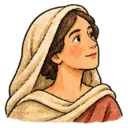
The three women imaginatively represent Mary Magdalene, Mary the mother of James the Little and Joses, and Salome watching from afar. Their shared gaze leads beyond the frame toward the crucifixion, which is not shown. Faces, ages, clothing and landscape are artistic conventions; the verse identifies the women without describing these details.
This imaginative recollection shows the women journeying toward Jerusalem, recalling their following and service to Jesus in Galilee and the many women who came up with Him. Jesus remains outside the frame. The basket, jug, clothing and city architecture suggest travel and practical service; the verse does not specify these details or the women's appearances.
This imaginative Jerusalem terrace gives visible form to the verse's evening setting. Bread, pottery and an oil lamp suggest household preparation before Sabbath; Mark does not specify these objects or this terrace. The architecture is an imaginative convention, not an archaeological reconstruction. No person or later burial action is depicted.
This imaginative audience depicts Joseph taking courage to ask Pilate for Jesus' body. His open hand and resolute posture express the petition; Jesus and His body remain outside the scene. The verse identifies Joseph as awaiting God's kingdom, without describing a visible kingdom. The men's appearances, clothing and Roman chamber are artistic conventions, not historical likenesses or archaeological certainty.
Pilate's raised brows and questioning hand imagine his surprise and inquiry to the summoned centurion about Jesus' death. Jesus remains outside the scene. The faces, Roman clothing and warm stone chamber are imaginative conventions, not historical likenesses or archaeological claims.
Pilate's open hand imagines his permission to Joseph after the centurion's report. Jesus' dead body is deliberately outside the picture; this is the grant of custody, not a bodily handover in the courtyard. The faces, clothing, gestures, and courtyard are imaginative conventions, not historical likenesses or an exact reconstruction.
This imaginative composition selects the verse's final action, rolling the stone against the tomb entrance after Jesus has been wrapped in linen and laid inside. Jesus and the burial linen remain out of view. The man's appearance, clothing, round stone, landscape and warm light are artistic conventions, not a historical likeness or a precise archaeological reconstruction.
The two women watching the tomb imaginatively represent Mary Magdalene and Mary the mother of Joses observing where Jesus had been laid. Their shared gaze emphasizes the verse’s act of watching; Jesus remains hidden. Their appearances, garments, garden, stone and evening colors are artistic choices, not details established by this verse or historical likenesses.
 ἀπήνεγκαν led away