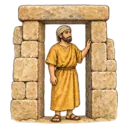
The illustration imagines the hungry disciples plucking and eating grain in Matthew 12:1. Three men, wheat, their clothing, and the landscape are artistic choices; the verse does not specify their number or the grain species. Jesus remains outside the frame. The Sabbath setting comes from the source text and is not visually marked.
The two men at left represent Pharisees objecting to Jesus about His disciples, represented at right. Jesus remains outside the frame. The grainfield, grain in their hands, gestures and landscape are imaginative setting details; this verse itself records the Sabbath accusation without describing the disciples' activity or Jesus' reply.
This imagined pause represents David and his hungry companions, whom Jesus recalls in His question. The empty bag and bowl make their hunger visible; the resting place, clothing and number of companions are artistic choices, not details stated in this verse. Jesus remains out of view, and the bread episode is not shown.
The sacred loaves and priest evoke the bread of the Presence, reserved for priests, while the travelers eating recall the event described in the verse. The sanctuary doorway, clothing, tray and two visible companions are imaginative choices; the verse does not specify their appearance or number.
This imaginative courtyard shows priests tending an altar, carrying wood and holding a service bowl. Their willing labor pictures the Sabbath service Jesus cites; their calm expressions suggest guiltlessness without denying His word 'profane.' The rolled scroll alludes to His appeal to the Law. The verse does not specify these particular tasks, people or architecture. Jesus is outside the image.
The distant temple and nearby listeners imaginatively juxtapose the temple's honored grandeur with Jesus' declaration that something greater is here. The listeners attend to Him beyond the frame; He is not pictured. The terrace overlooking the temple is an artistic setting, not a location stated by this verse. Warm sunlight conveys attentive wonder rather than a depicted supernatural event.
These imagined travelers are not a recorded incident from the verse. Sharing bread pictures mercy, while the background altar recalls the mention of sacrifice. The seated traveler's dignified treatment invites reflection on Jesus' rebuke against condemning the guiltless. Neither traveler represents Jesus.
This imagined Sabbath setting pairs an unused work tool and resting listeners with attentive faces turned toward a speaker outside the picture. Their listening suggests recognition of the Son of Man's authority over the Sabbath. The verse states that authority; it does not describe these people, objects or this gathering. Jesus is kept outside the image.
The path and open synagogue doorway imagine the destination of Jesus' movement in Matthew 12:9 while keeping Him outside the visible scene. The stone building, olive tree, scroll and two seated worshippers are illustrative setting details that the verse does not specify. The image does not depict a healing or another subsequent event.
The seated pose, stone room, clothing and gestures are imaginative staging for the man with a withered hand and the question asked to accuse Jesus. The standing men direct their attention beyond the frame, keeping Jesus unseen. The hand remains contracted: this illustrates the question about Sabbath healing, without depicting the later healing.
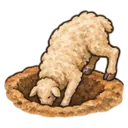
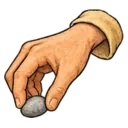
This imaginative scene pictures the hypothetical rescue in Jesus' question, not a separately reported event. One sheep, the visible pit and the owner's supporting hands connect directly to taking hold and lifting it out. The peaceful hillside supplies an imagined setting; it does not visibly establish a Sabbath. Jesus remains outside the image.
The imagined act of offering water illustrates doing good and honoring human worth; the resting sheep recalls the verse's explicit comparison. This courtyard encounter is illustrative, not an event narrated in the verse or a depicted healing. Both men are unnamed neighbors, and Jesus is outside the composition.
The extended, healthy hand pictures the restoration after the man obeys Jesus; his other open hand echoes the verse's comparison. Jesus remains outside the frame. The man's expression, clothing and simple stone interior are imaginative staging, not details specified by this verse.
The close, tense council imagines the Pharisees taking counsel against Jesus with the intention of destroying him. The four figures, their gestures and the stone courtyard are illustrative details, not details specified by the verse. Jesus remains outside the frame. No assault is shown: the verse describes their murderous planning.
This imagined countryside procession pictures the many who followed Jesus and the gratitude of those He healed. Jesus remains beyond the bend, outside the frame; no visible person is the healer. The olive grove, village, individual people and their gestures are artistic details, not particulars supplied by the verse. The image suggests the outcome of His healing rather than reconstructing how each cure occurred.
The quiet listeners imaginatively evoke those receiving Jesus' firm warning not to make Him known. Jesus stays outside the frame. Their number, clothing, gestures and hillside setting are artistic choices, not details stated in the verse; their attentive silence suggests the restraint His instruction requires.
This imaginative still life uses the scroll to recall the word spoken through Isaiah. The sunlight and continuing path suggest fulfillment. Matthew 12:17 does not describe this setting or these objects; the unmarked parchment avoids inventing the prophecy's wording.
The varied listeners imagine the nations receiving the chosen servant's proclamation of justice. This harbor gathering is an imaginative setting, not a meeting reported in the verse. Jesus remains outside the frame; God's delight and the gift of His Spirit are affirmed by the text rather than depicted as visible beings.
This imagined village street reflects the verse through its open space and absence of quarrelling or public outcry. The ordinary villagers are artistic additions. Jesus remains outside the picture; this is a meditation on His uncontentious manner, not a recorded incident or a claim that He never spoke publicly.
This imagined lakeshore still life brings together the verse's bruised reed and smoldering flax wick, preserved rather than destroyed. It pictures Christ's gentleness without portraying Him. The dawn suggests hope; it does not literally depict His bringing justice to victory.
This imagined gathering of Gentile travelers pictures the nations' promised hope in Jesus. Their shared gaze is directed beyond the right edge, leaving Him unseen. The harbor suggests different homelands; the verse does not describe this particular gathering, landscape, or clothing. Daylight is ordinary illumination, not a substitute for Him.
This imaginative scene concentrates on the man's restored sight and speech after Jesus heals him. Jesus remains outside the frame. The courtyard, clothing and companions' gestures are imagined details, not specified by the verse. Demon possession is part of the verse's account, acknowledged in the explanation without inventing a visible spirit or ritual.
The crowd's amazed faces and the two neighbors' questioning exchange imaginatively express the verse's astonishment and question about the Son of David. Jesus remains outside the frame as the unseen focus. The courtyard, clothing, gestures and individual faces are artistic choices, not details specified by this verse; the picture does not turn their question into a coronation or formal declaration.
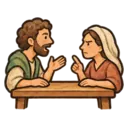
The three speakers imaginatively represent the Pharisees making their accusation. Their tense discussion and outward gesture evoke speech about Jesus, who remains outside the frame. The courtyard and exact poses are reconstructed details. No demons appear: the verse records the charge that He works by Beelzebul, rather than a visible demonic event.
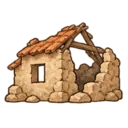
The divided household beside its broken shared home and the ruined town imaginatively picture Jesus' warning that internal division brings desolation and prevents a kingdom, city or household from standing. The verse does not narrate this building collapse; the architecture is a visual analogy, and Jesus remains out of view.
This is an imaginative teaching model, not a recorded event. Its single kingdom, broken through its own foundation, illustrates Jesus' conditional argument: if Satan casts out Satan, his kingdom is divided against itself and cannot stand. No figure represents Jesus, God or Satan.
The courtyard gathering and balance are imaginative, not details stated in the verse. The equal stones suggest applying the same standard to Jesus and the accusers' own exorcists. The younger men evoke the sons or followers whose work challenges the accusation. Jesus is not depicted, and no exorcism is staged.
The courtyard and people are imaginative, not details specified by the verse. The central man represents someone delivered, not Jesus; departing violet wisps suggest expelled demons. Ordinary daylight and grateful witnesses evoke God's reign already arriving. Jesus remains outside the frame; the Spirit is not pictured.
This imagined household illustrates Jesus' comparison, rather than a recorded burglary or a portrayal of Jesus. The restrained strong man and the goods being carried away express the sequence He states: first bind the strong man, then plunder his house. The setting and household details are artistic choices.
This imagined harvest contrasts a worker binding wheat with another walking away and letting cut stalks fall apart. It illustrates Jesus' opposition between gathering with Him and scattering, rather than documenting an event in the verse. Neither worker portrays Jesus.
This imagined group listens to Jesus outside the frame. Their sober attention reflects both the promise that sin and blasphemy will be forgiven and the grave exception: blasphemy against the Spirit will not be forgiven. The courtyard and gestures are artistic inventions, not details given by this verse, and no listener is identified as guilty of that sin. The Spirit is not visually represented.
This imagined gathering of listeners invites reflection on Jesus' solemn distinction between forgiveness for a word against the Son of Man and no forgiveness for speaking against the Holy Spirit, in this age or the coming age. The hand near the lips recalls the weight of speech; open and folded hands suggest differing responses. The verse does not describe this courtyard or these people, and the image assigns no one a verdict. Jesus and the Holy Spirit remain unseen. Human artwork review is pending.
The two fig trees are an imaginative illustration of Jesus' comparison, not a recorded orchard visit. Sound fruit and spoiled fruit make each tree's condition visible. The verse does not specify a fruit species or setting.
The jug's dark contents pouring through its mouth imaginatively connect the heart's abundance to spoken words. Three vipers recall Jesus' sharp address, offspring of vipers. This is a symbolic still life, not a recorded courtyard event. No figure represents Jesus or God. Human artwork review remains pending.
An imaginative still life, not a recorded event: the two stores picture the good and evil treasure in the verse. Wholesome provisions and harmful thorns with spoiled fruit show how what comes forth corresponds to what is stored within. The objects are metaphors for moral character, not a claim that food or possessions determine goodness.
An imagined listener reflects on his speech. The blank scroll, stones and balance are illustrative metaphors for giving account of every careless word on judgment day; the verse describes neither these objects nor this courtyard. The man is not Jesus, and no final-judgment event is depicted.
This imaginative still life is not an event described in the verse. The scrolls stand for a person's own words, and the scales recall the verdicts of justification and condemnation. Light and shadow emphasize those contrasting outcomes; they neither depict God nor imply that good words cancel evil words.
This imagined courtyard scene visualizes the scribes and Pharisees asking their unseen Teacher for a sign. Their attentive faces and open hand express the request; Jesus remains outside the frame. The verse does not name the location, clothing or number of speakers, and no sign is shown as having occurred.
This imaginative shore scene evokes Jonah, the prophet Jesus names as the sole sign. The shore and departing fish recall Jonah's story; they are not details narrated in Matthew 12:39 or a depiction of Jesus' audience. The humbled posture is an artistic choice. The verse rebukes an evil and adulterous generation for seeking a sign.
This imaginative coastal pairing compares the creature that held Jonah with a closed tomb recalling the Son of Man in the heart of the earth. Their shared shoreline is an artistic comparison, not a historical claim. Twilight suggests waiting without attempting to count or shorten the three days and three nights. Neither Jonah nor Jesus is shown.
This imaginative view of Jonah preaching in Nineveh illustrates the repentance Jesus cites as grounds for the Ninevites' future condemnation of His generation at the judgment. The architecture, faces and gestures are artistic choices. It does not depict the future judgment or Jesus, the One greater than Jonah whose presence makes the comparison so solemn.
This imagined visit recalls the queen's journey to hear Solomon, the reason Jesus gives for her condemnation of this generation at judgment. The courtyard, clothing and caravan are artistic details. Jesus and the future judgment remain outside the picture; the verse declares that One greater than Solomon is here.
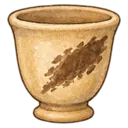
This imagined waterless ravine illustrates the spirit's fruitless search for rest. The dark wisp is an artistic suggestion of the unclean spirit, not a claim about its visible form. Its departure from the person is outside the composition, and no later return is depicted.
This imagined ancient house visualizes the verse's house imagery rather than a documented building. The clean floor, broom, and arranged vessels show it swept and put in order; the vacant center emphasizes that it is unoccupied. The returning speaker remains unseen.
The house is an imaginative metaphor for the man, not a separate event asserted by the verse. The lighter wisp and gathering darker streams evoke the returning spirit and seven more wicked companions dwelling there, making his condition worse. The nearby village extends the image toward Jesus' warning about this evil generation. The shadows do not claim to show spirits' actual appearance.
The waiting woman and men imaginatively represent Jesus' mother and brothers, and the shaded gathering recalls the crowds He was still addressing. Jesus remains out of view. The house, gestures, clothing and appearances are illustrative; the verse does not specify these details or explain why His family wished to speak.
The messenger's open hand connects his report to the mother and brothers standing outside. The doorway, clothing, expressions and two representative brothers are imaginative staging, not details specified by the verse. Jesus remains outside the picture.
The listening group imagines the pause after Jesus asks who His mother and brothers are. Jesus remains outside the frame; the central man represents the person He answers. The older woman and other adults evoke family without claiming to identify His relatives. The setting and expressions are artistic choices, not details specified by the verse.
The open hand represents Jesus' gesture toward His disciples, while His face and body remain outside the image. Their close grouping evokes His words calling them His mother and brothers. The number, faces, clothing, house and light are imaginative setting details, not details specified by the verse.
This imaginative gathering uses caring fellowship among ordinary disciples to evoke the brother, sister and mother relationship Jesus names for whoever does His heavenly Father's will. The courtyard and offered water are artistic choices, not details narrated in this verse. Jesus and the heavenly Father are not depicted.
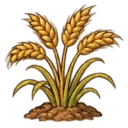 σπορίμων grainfields
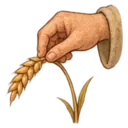 τίλλειν To pluck; pick heads of grain.
 στάχυας heads of grain