This imagined gathering connects the believers’ quiet joy with Paul’s command to rejoice in the Lord. The held letter and additional rolled scroll suggest written encouragement repeated for their safeguard. The verse does not narrate this courtyard meeting; the letter is not a magical guarantee of safety, and the Lord is not depicted.
This is an imaginative teaching scene, not an event narrated by Paul. The watchful adults picture the repeated command to beware. The dogs echo his figurative warning; the damaged linen and closed sheath indirectly suggest harmful work and cutting. These objects do not depict a bodily rite or identify an ethnic group as evil.
This imaginative gathering evokes worship by the Spirit and glorying in Christ through thankful faces and open, empty hands. The verse does not narrate this event or name these people. Their simple fellowship suggests humility rather than confidence in bodily status; clothing and gestures cannot themselves establish spiritual identity. Circumcision is not pictured, and neither God nor Christ is depicted.
This imaginative still life uses the larger and smaller scroll groups to suggest Paul's comparison, "I more," about grounds for human confidence. The open hand indicates the larger group. The verse does not describe scrolls, this room or this gesture; they are a visual analogy, not a recorded event or a claim that credentials deserve ultimate trust.
This imaginative still life is not a recorded event from Paul's life. The empty infant cloth and eight pebbles recall circumcision on the eighth day without depicting the rite. The rooted olive tree evokes inherited belonging, and the closed scrolls suggest his formation in the Law. No object specifically identifies Benjamin, and the courtyard is not a reconstruction of his home.
This imagined doorway encounter evokes Paul's former persecution of the church through his commanding gesture and the believers' concern. His closed scroll suggests his confidence in observance of the Law, placing the verse's two claims in tension without making persecution righteous. The verse specifies no such encounter, scroll, house or clothing; these are illustrative choices, not historical particulars.
This imaginative scene visualizes Paul's reassessment of his former gains because of Christ. The set-aside sash and ring suggest status and advantage; the verse does not name these possessions or narrate this event. His empty hand and peaceful resolve suggest relinquished reliance on those gains. The courtyard light is ordinary sunlight, not a depiction of Christ, who remains unseen.
This imaginative scene gives visible form to Paul counting former gains as refuse: possessions lie beside swept-up scraps while his empty hands express devotion to Christ. The setting, appearance and objects are artistic choices, not a recorded event or historical likeness. Jesus is not depicted, and the sunlight is ordinary daylight. The scene does not imply that loss purchases Christ.
This imaginative courtyard scene expresses receptive trust through the man's empty, open hands and quiet gratitude. The intact scroll recalls the Law without suggesting that it is evil or discarded. Neither this setting nor these gestures are narrated in the verse. The ordinary sunlight supports the mood; it does not depict God. The picture cannot literally show being found in Christ or righteousness from God, which the verse names as received through faith rather than derived from one's own Law observance.
This imaginative devotional setting brings the cross and empty tomb together to recall Christ's death and resurrection. The path through the cross's shadow toward the open tomb suggests Paul's desire to know Christ through both suffering and resurrection power. The arrangement is not a recorded event or a claim about the tomb's historical surroundings.
This imagined burial-place threshold opening toward a living garden evokes Paul's longing to attain resurrection from the dead. The empty bench acknowledges death; the ascending steps and dawn suggest hope toward life. The verse does not describe this setting or a tomb visit, and ordinary sunrise is not itself resurrection or a portrayal of God.
This imaginative traveler suggests Paul continuing to pursue without claiming to have arrived or been perfected. The unfinished uphill path is a visual metaphor, not a narrated event or a picture of earning salvation. Christ Jesus, who has already taken hold of Paul, remains outside the image; the landscape does not represent Him.
The runner is an imaginative analogy for Paul's forward-reaching resolve, not a depiction of a recorded event or a historical likeness. His gaze and outstretched hand face the continuing path; the receding footprints suggest leaving what is behind. No arrival or completed victory is shown. The landscape supplies an imagined setting, not a location named in the verse.
The runner, uphill path, goal and waiting wreath imaginatively connect pressing on, the goal, the prize and the upward calling. This is a visual analogy, not a recorded race involving Paul. The wreath does not define the heavenly prize, and the sunlight does not depict God. The verse locates the calling in Christ Jesus, who remains outside the image. Artwork remains pending human review.
This imaginative gathering is not a recorded encounter. Patient listening pictures the shared mindset and teachability Paul urges. The path becoming clear in morning light offers an analogy for understanding God will reveal; the sunlight is ordinary landscape light, not a depiction of God. The figures are anonymous, and their clothing and setting are illustrative conventions.
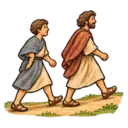
The unnamed travelers sharing one continuous path imaginatively express the call to keep walking in line with what has already been attained. Their steady common direction suggests faithful ongoing practice, not completed perfection. The people, countryside and village are illustrative choices; the verse does not narrate this journey.
This imagined community makes the verse's language of walking visible as shared conduct: attentive companions learn from mature examples. It does not portray a recorded gathering or claim Paul was present. The setting, faces and gestures are artistic conventions; the verse calls for joint imitation of Paul and attention to those who follow the shared example.
This imaginative portrait evokes Paul composing his tearful warning about people whose way of life opposes the cross of Christ. The tears express his sorrow; the pen and blank parchment suggest the letter. The room, clothing and appearance are artistic conventions, not details supplied by this verse or a historical likeness. Neither Christ nor the people described are pictured.
This is an imaginative warning, not a recorded gathering. Absorption in the feast and possessions suggests appetite ruling the heart and minds fixed on earthly things. The raised cup and fading wreath suggest misplaced boasting; the collapsing foundation evokes their destructive end. The verse does not name these objects or this setting, and ordinary food is not itself condemned.
This imaginative community illustrates the shared heavenly citizenship and eager waiting expressed in the verse. Their upward gaze suggests expectation of the Savior, the Lord Jesus Christ, who remains unseen. The town is an earthly setting, not a depiction of heaven, and the warm sky is atmospheric light, not a portrayal of God. These people and this gathering are illustrative, not a recorded event.
This imaginative scene uses solid, upright bodies and joyful faces in radiant light to evoke the promised transformation of our lowly body into conformity with Christ's glorious body. The broad landscape suggests the reach of His power over all things. The verse does not describe this hillside gathering; the light is an artistic cue, and Christ remains outside the picture.