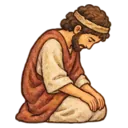
This imaginative portrait recalls Abraham, the forefather named in the verse. His thoughtful expression and open hand invite reflection on Paul's question about what Abraham discovered. The tent and hills provide an imagined patriarchal setting; the verse does not describe this scene or supply its answer here.
This imagined still life uses fine handiwork to suggest deeds and an unworn wreath to suggest grounds for boasting. Their modest setting beneath an open sky reflects Paul's denial of boasting before God. The verse does not describe these objects or an episode in Abraham's life; the dawn light is natural, and God is not depicted.
This imaginative reading alcove evokes receiving Scripture's testimony with trust. The open hand suggests receptiveness; the scroll recalls the verse's question about what Scripture says. It does not depict Abraham or the moment his faith was counted as righteousness, which the verse states rather than physically describes. The setting and reader are artistic conventions. Artwork remains pending human review.
This imagined stoneworker and employer illustrate the verse's comparison of wages with a debt that is due. The tools and cut stones make the labor visible; the coins represent payment owed rather than a gift. The people and courtyard are illustrative inventions, not a recorded scene or historical likeness.
Empty hands and unused tools suggest reliance on God rather than work offered to earn righteousness; the blank scroll evokes reckoning. The anonymous man stands for the ungodly person who trusts God. This is an imaginative teaching scene, not an event narrated in the verse; the natural sunlight does not depict God.
This imagined courtyard meditation illustrates blessedness received apart from works: the unnamed man's empty palms suggest that he brings no payment or achievement. The blank scroll alludes to crediting righteousness without pretending to show God's account. Ordinary sunlight conveys gladness. The verse describes no such event; David is cited as a witness and is not portrayed. God is not depicted.
This imagined scene gives no named event or historical likeness. The grateful adults suggest the blessedness of people forgiven; the set-down stones and loosened straps suggest released guilt, while the linen echoes sins covered. These objects are teaching metaphors, not objects named in the verse or actions that earn pardon.
This is an imagined illustration of a saying, not a narrated event. The man's quiet relief pictures blessedness; the unmarked accounting tablet and unused stylus echo sin not being reckoned against him. They do not imply that he never sinned, erased his own guilt or earned pardon. The courtyard and unnamed man are artistic inventions; the Lord remains unseen.
This imaginative still life uses two differently made cups sharing one light to suggest Paul's question about blessing for the circumcised and uncircumcised. It depicts no narrated event, Abraham, or circumcision. The water and light are visual analogies, not objects named in the verse; the verse grounds the question in Abraham's faith being credited as righteousness.
This imaginative still life uses an open scroll and an unused seal as an analogy for reckoning before a later sign. Romans 4:10 says righteousness was credited to Abraham while he was uncircumcised. The objects and tent are illustrative inventions, not an event described in the verse, and the seal is not a literal depiction of circumcision.
This imaginative still life uses the small seal to suggest confirmation and the open path to suggest the inclusion of all who believe. The objects are teaching metaphors, not artifacts or an event described in Romans 4:11. Circumcision itself is left unseen; the verse says it sealed righteousness already received through faith.
This imagined landscape gives visible form to walking in the footsteps of Abraham's faith. The travelers are unnamed, not Abraham and companions in a recorded event. Their shared path illustrates following his example; the image does not depict circumcision or claim that clothing reveals anyone's covenant status.
This imaginative composition pairs empty, receptive human hands with an expansive landscape to evoke faith receiving the promised inheritance. The resting scroll recalls the law without making it the means of receiving the promise. It illustrates the verse's teaching, not a recorded event, a likeness of Abraham, or an appearance of God.
This imaginative still life illustrates Paul's conditional reasoning, not a recorded event. The chest suggests inheritance and the scales a claim based on law; the empty vessel pictures faith emptied of its force, while the closed roll suggests a promise made ineffective under that condition. The objects are visual analogies, not objects named in the verse or a claim that God's promise has failed.
This imagined landscape uses plain tablets and a stone boundary to suggest law, footprints crossing the boundary to suggest transgression, and the gathering storm to suggest wrath. Paul describes no such place or event. The open ground does not represent a claim that people without law are sinless.
This imagined household meal pictures the promise received as grace through faith: open hands receive freely shared bread, and people of different backgrounds share one table. It is a visual analogy for Abraham's family of faith, not an event narrated in Romans 4:16. The unnamed figures do not portray Abraham, God, or Jesus.
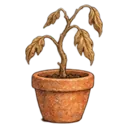
The imagined shoot growing from a weathered stump offers a natural analogy for God's life-giving power. Its spreading branches suggest the breadth of the promise that Abraham would be father of many nations. The verse speaks of God's power over death and His call concerning what does not exist; the hillside and tree are illustrative inventions.
This imaginative landscape uses the old tree's many living branches on a stony hillside to suggest hope beyond ordinary expectation and the promised multitude of descendants. It illustrates Paul's reflection on Abraham's trust; the verse does not describe a tree or this landscape, and the stars are an artistic setting rather than a depicted divine appearance.
This imaginative portrait of Abraham relates his aged face and hands to the body's deadness in Romans 4:19, while his settled expression suggests faith that does not weaken. Sarah's inability to conceive is acknowledged in the verse explanation; she remains offstage. The tent, pose, and landscape are artistic choices, not a scene narrated by Paul.
This imagined worshipper's steady kneeling posture, lifted gaze and open hands picture being strengthened in faith and giving glory to God rather than wavering in unbelief. The tent, landscape and dawn are artistic setting choices; the verse does not describe this scene or a visible appearance of God.
This imagined, unoccupied camp uses firm tent ropes and a steady lamp to suggest settled assurance, while the wide evening sky evokes God's greatness. The objects are illustrative choices, not objects named by the verse; no promise encounter or fulfillment is being reenacted, and God is not pictured.
The blank account scroll imaginatively suggests being credited, while the clean linen suggests righteous standing. Their placement together illustrates the teaching; the verse does not describe these objects or a visible ceremony. No divine figure is depicted.
Three anonymous readers sharing one scroll imaginatively express that the written testimony was not for one person alone. This is a teaching composition, not an event described in the verse or a portrait of Abraham or Paul. The scroll has no visible lettering to keep the artwork text-free.
This imaginative garden meditation joins an empty tomb, recalling Jesus' resurrection, with a believer's receptive hands, suggesting trust in the God who raised Him. Romans 4:24 teaches about believers and credited righteousness; it does not narrate this garden visit or specify these details. Neither God nor Jesus is depicted.
The distant empty cross recalls Jesus being delivered over for our trespasses; the open, empty tomb points to His being raised for our justification. Dawn and the flowering garden express reverent joy. This is an imaginative composition of related details, not a setting described in Romans 4:25 or a claim of historical reconstruction.
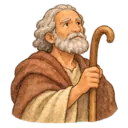 προπάτορα father