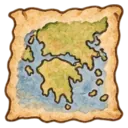
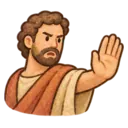
The traveler approaching the city imagines the arrival in Corinth after departure from Athens. His clothing, satchel, road, plants and city buildings supply an illustrative setting; the verse does not specify these details or the route. No meeting or teaching scene is added.
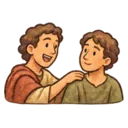
The greeting imagines Paul approaching Aquila and Priscilla. The doorway, clothing, faces and travel bundles are artistic choices; the bundles suggest their recent arrival from Italy after Claudius ordered the Jews to leave Rome. The verse does not describe this precise setting or their expressions. No historical likeness is claimed. Artwork remains pending human review.
The shared cloth and coordinated handwork imagine the verse's common trade and working together. A mat and bundle by the doorway suggest staying with the household. The people, clothing, tools and courtyard are imaginative choices, not verified likenesses or an exact reconstruction; the verse does not specify these workshop details.
This imaginative synagogue gathering represents one moment in Paul's repeated Sabbath reasoning with Jewish and Greek hearers. The scroll and exchanged gestures emphasize thoughtful discussion and persuasion rather than unanimous acceptance. Faces, clothing and architecture are artistic conventions, not historical likenesses or archaeological claims; one image cannot show the recurrence of every Sabbath.
Paul's earnest gesture and attentive listeners picture his testimony that Jesus is the Christ. The two travelers suggest Silas and Timothy arriving from Macedonia. Faces, clothing, room, scroll and table details are imaginative conventions, not details specified by the verse or historical likenesses. Jesus is not depicted. Artwork remains pending human review.
The garment-shaking illustrates Paul's sober response to opposition. The open street suggests his announced mission to the Gentiles without depicting a later encounter. The warning about blood concerns responsibility and is not shown as literal injury. Faces, clothing and architecture are imaginative conventions, not historical likenesses or archaeological certainty.
The arrival at the home illustrates coming into Titius Justus's house; the shared wall with the neighboring meeting building emphasizes that it adjoined the synagogue. The welcoming gesture, faces, clothing and architecture are imaginative conventions, not details specified by the verse or verified historical reconstructions. God is not pictured.
The gray-bearded man and nearby group imaginatively represent Crispus and his believing household; the wider gathering and baptism recall the Corinthians who heard, believed, and were baptized. The verse does not identify this baptizer or specify a pool, household membership, faces, clothing, or architecture. These are illustrative choices, not historical likenesses. The Lord is not depicted.
Paul's attentive upward gaze and open hand imaginatively express receiving the Lord's nighttime encouragement to speak without fear. The Lord remains outside the picture. The room, clothing, lamp and Paul's appearance are artistic conventions, not details specified in this verse or a reconstruction of the vision's visible content. Human artwork review remains pending.
Paul's attentive peace indirectly evokes the Lord's assurance of presence and protection; the inhabited city recalls His many people there. The room, night view, clothing and townspeople are imaginative details, not a recorded scene or historical likeness. The townspeople are not individually identified as believers, and the divine speaker is not pictured.
The teacher represents Paul sharing the word of God among the people. This imagined courtyard gathering gives a quiet glimpse of the sustained teaching described in the verse; it does not depict all eighteen months. The faces, clothing and setting are artistic conventions, not historical likenesses or a documented meeting place.
The group surrounding Paul and the man holding his arm visualize the united opposition and his being brought before the judgment seat. The seated official represents Gallio. The courtyard, clothing, gestures and faces are imaginative conventions, not historical likenesses or archaeological certainty. The scene stops before any verdict and illustrates this particular group rather than making a claim about Jewish people generally.
The speaking man and seated official imaginatively place the accusation in a civic hearing, with Paul standing quietly between them. The gestures express the charge being made, not its truth. Faces, clothing and Corinthian architecture are imaginative conventions, not verified likenesses or archaeological reconstructions. God and the worship mentioned in the accusation are not pictured.
The standing man represents Paul poised to answer, while Gallio speaks first to the Jewish complainants. Their gestures illustrate the timing of the verse; no hypothetical crime is pictured. Faces, clothing and the Roman courtyard are imaginative period conventions, not known likenesses or a certain reconstruction.
This imaginative tribunal scene relates Gallio's open hand and the petitioners' appeal to his refusal to judge their questions about words, names, and law. It does not portray a ruling on religious truth or the later expulsion and violence. Faces, garments, architecture, and vegetation are artistic conventions rather than verified historical details.
The departing group and the magistrate's firm gesture visualize driving them away from the judgment seat. The attendant, faces, clothing and classical courtyard are imaginative staging, not details specified by this verse or verified historical likenesses. No beating or later event is shown. Artwork remains pending human review.
The crouching man represents Sosthenes; the encircling men and raised fist convey the seizure and beating without showing impact or wounds. The seated official looking away represents Gallio's unconcern. Faces, clothing and the Roman court setting are imaginative conventions, not historical likenesses or an exact reconstruction. The attackers are not assigned an ethnic or religious identity.
This imaginative harbor departure brings together the verse's farewell and sea journey with Priscilla and Aquila. Paul's closely shorn head recalls the vow-related detail at Cenchreae without inventing its terms or ceremony. Faces, clothing, ship and harbor are artistic conventions, not historical likenesses or an archaeological reconstruction. Human artwork review remains pending.
The scene imagines Paul reasoning with Jewish listeners in the synagogue at Ephesus, the final action in the verse. His companions being left there is not separately pictured. Faces, garments, architecture, the scroll and conversational gestures are illustrative choices, not details specified by the source or historically verified likenesses.
The inviting hand toward the bench and the traveler's raised palm imaginatively express the request to stay longer and his refusal. The traveler represents Paul; the hosts, gestures, courtyard and clothing are artistic conventions, not details supplied by this verse or historical likenesses. No reason for his refusal is invented. Artwork remains pending human review.
The traveler represents Paul as he leaves Ephesus. His farewell gesture and the water opening between ship and quay connect taking leave with sailing away. His hoped-for return remains subject to God’s will; no divine figure or sign is depicted. Faces, clothing, ship and harbor architecture are imaginative period conventions, not historical likenesses or a precise reconstruction. Artwork remains pending human review.
This imaginative scene selects the greeting of the church from the verse. The gathered people represent the believing community, while the traveler's satchel suggests his journey. It does not depict all stages of the itinerary at once. Faces, garments and the domestic courtyard are artistic conventions, not historical likenesses or a verified location.
This imaginative gathering represents Paul strengthening disciples during his journey through Galatia and Phrygia. Attentive faces and his gentle speaking gesture suggest encouragement in faith, while the receding road suggests onward travel. The verse does not specify this meeting, its participants, the village, clothing or landscape; these details are illustrative conventions, not historical likenesses or a verified location.
The traveler represents Apollos arriving in Ephesus; his carefully held scroll evokes his strength in the Scriptures. The verse also identifies him as Jewish, Alexandrian and eloquent. His face, clothing and the city architecture are imaginative conventions. This quiet pause with the scroll is an illustrative relationship, not a separately recorded event or an exact historical reconstruction.
The imagined teacher and listening circle express fervent, careful instruction about Jesus. The courtyard, faces, clothing and scroll are illustrative choices, not documented details. His knowledge being limited to John's baptism is explained by the verse rather than pictured as a baptism; neither John nor Jesus is shown. Artwork remains pending human review.
The imagined courtyard conversation focuses on Priscilla and Aquila explaining God's way more accurately to the speaker they heard in the synagogue. Their open gestures and his attentive posture express personal instruction and receptiveness. Faces, clothing and architecture are artistic conventions; the verse does not specify this setting. God's way is conveyed through teaching, not pictured as a literal road. Human artwork review remains pending.
This imaginative welcome in Achaia centers on the letter connecting the sending brothers with the receiving disciples. The gathered believers suggest the community Apollos would greatly help; the verse does not specify this courtyard, their appearances or their gestures. Grace is not given a visible form. The supplied Berean token glosses are uncurated source aids, not an approved translation.
The open scroll and earnest exchange picture the verse's public, vigorous argument from the Scriptures that Jesus is the Christ. Jesus is spoken about rather than shown. The courtyard, clothing, faces, and gestures are imaginative details, not recorded historical particulars. The unlettered parchment avoids inventing a quotation. The image does not imply that every listener accepted the argument.
 Κόρινθον Corinth