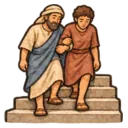
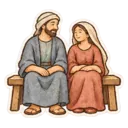
The uphill road and Jerusalem destination illustrate the movement stated in the verse. Festus is imagined as the leading Roman official; his appearance, clothing, two companions and the detailed landscape are illustrative choices, not details supplied by the text. The image does not depict the three-day interval or claim that the journey lasted three days.
Festus's open-handed reply represents his answer about Paul's custody in Caesarea. Paul remains offstage. The bag suggests Festus's intention to leave soon; the listeners, courtyard, costume and props are imaginative conventions, not details supplied by this verse or verified historical likenesses.
This imagined audience shows Festus instructing representatives to accompany him and present any accusation. Paul is absent because he is being discussed, not addressed. The steps and distant hills evoke the proposed journey rather than a completed trip. Faces, clothing and architecture are illustrative conventions, not verified likenesses or a reconstruction.
The seated governor and approaching Paul imaginatively show the command to bring Paul being carried out. The verse reports the summons after the governor returns to Caesarea; it gives no verdict. Morning light suggests the following day. Faces, clothing, furnishings, and harbor architecture are artistic conventions, not known likenesses or an exact reconstruction.
The central man represents Paul, with standing accusers conveying the pressure of many serious charges. The seated foreground listener, faces, clothing and Roman-style hall are imaginative setting details, not historical likenesses. The verse says the accusers could not prove their charges; their gestures do not supply proof or portray the alleged offenses. Artwork remains pending human review.
Paul's open hand and composed expression illustrate his spoken defense. The listening official and sunlit hearing hall are imaginative staging, not historical likenesses or an exact reconstruction. The official is not Caesar; Jewish law, the temple and Caesar are subjects of Paul's denial, not objects or absent people placed in the scene. No verdict is shown. Human artwork review remains pending.
This imaginative courtroom scene links Festus's open-handed question to Paul's attentive stance, with the Jewish party nearby to recall the favor Festus seeks. Jerusalem is only the proposed place of judgment, so no journey is shown. The faces, clothing and architecture are artistic conventions, not historical likenesses or archaeological claims; the image cannot itself reveal Festus's motive.
This imagined Roman hearing gives visual form to Paul's appeal to Caesar and refusal to be handed over without a valid charge. His steady posture suggests his willingness to face lawful judgment. Faces, clothing and architecture are illustrative conventions; Caesar is not shown.
The scene imagines Festus announcing the ruling to Paul after consulting his council. The three advisers evoke that consultation; their number, faces, clothing and the Roman chamber are artistic reconstruction. Caesar is the destination named in the ruling and is not shown. The journey has not begun.
Agrippa and Bernice are imagined arriving together to greet Festus in Caesarea, as the verse says. The open-handed reception makes the greeting visible; the coastal portico, clothing and faces are artistic choices, not details specified by the verse or verified historical likenesses.
The painting imagines Festus explaining Paul's case to the king. Faces, clothing, scrolls and the sunlit reception room are illustrative conventions, not details established by this verse or historical likenesses. Paul and Felix are discussed rather than shown; this is not Paul's later appearance before the king.
An imaginative reconstruction of the Jerusalem petition reported in the verse. The spokesman's appeal and the governor's attentive posture show the leaders seeking condemnation, without depicting a verdict. The accused man remains absent. Faces, dress and architecture are artistic conventions, not known likenesses or archaeological certainties.
This imaginative scene shows the speaker giving the reported reply: Roman custom requires an accused person to face the accusers and have a chance to answer the charge before being handed over. The raised hand suggests refusal of a premature surrender. The accused remains offstage; the faces, garments and room are artistic conventions, not documented likenesses or a claim that this is the trial itself.
This imaginative reconstruction shows the hearing recalled in the verse: a seated official receives the man under escort while the assembled parties watch. Morning light suggests the following day; the absence of delay belongs to the verbal account. Faces, clothing, plants and architecture are imagined details, not historical identifications. No verdict is shown.
This imaginative reconstruction shows the hearing being recalled: standing accusers address a thoughtful Roman official while the accused waits quietly. The official's questioning posture suggests the mismatch between his expectation and their allegations. The verse does not report an acquittal or the absence of every accusation. Faces, clothing and architecture are illustrative conventions.
An imagined provincial governor and visiting dignitary discuss the reported dispute. Their attentive exchange represents the report about Jesus' death and Paul's affirmation that He lives; neither Jesus nor Paul appears. Faces, clothing, room and gestures are artistic conventions, not historical likenesses or archaeological claims.
This imaginative scene depicts the earlier question Festus recalls: uncertain about the inquiry, he asks Paul whether he is willing to be tried in Jerusalem. The questioning hand and attentive listener convey the exchange without implying agreement or a verdict. Faces, clothing, furnishings and architecture are artistic conventions; Jerusalem is not pictured because the journey is only proposed.
This imaginative scene shows the continuing custody described in the governor's report: Paul waits under Roman guard after appealing to Caesar. It does not depict a verdict or departure. Paul's appearance, the guard, furnishings and architecture are artistic conventions, not historical likenesses or details specified by the verse. Artwork remains pending human review.
Agrippa’s attentive posture and Festus’s open hand imaginatively convey the request and the assurance of a hearing tomorrow. The man they discuss is absent; the promised hearing has not begun. The faces, clothing and Roman-style room are artistic conventions, not established likenesses or an exact historical reconstruction.
The painting imagines Paul being brought before the assembled authorities in Acts 25:23. The seated Agrippa and Bernice, Festus's gesture, commanders, and prominent citizens express the verse's ceremonial pomp. Faces, garments, furnishings, and architecture are illustrative choices, not historical likenesses or archaeological claims. The image shows his arrival, before any speech or verdict.
The scene imagines Festus presenting Paul to Agrippa. His open hand and the attentive faces convey the hearing in which he reports the demand for Paul's death. The cries he recounts are not staged as a present mob. Faces, garments and the chamber are artistic conventions, not verified historical likenesses or architecture. Human artwork review remains pending.
This imagined hearing represents Festus explaining his decision about Paul: he found no deed deserving death, but would send Paul to the emperor following his appeal. The chain and guard show continued custody. The faces, clothing, architecture and document roll are imaginative conventions, not recorded likenesses or a claim of exact historical appearance. The emperor is not shown, and the journey has not begun.
The unwritten scroll and the governor's questioning gesture picture his lack of a definite report. The king's attentive pose and the prisoner's presence picture the hoped-for examination. The hall, faces, garments and props are imaginative period conventions, not verified likenesses or exact details stated in this verse. No outcome is shown.
The official's questioning gesture, unlettered scroll, and chained prisoner imaginatively connect the need to state accusations with the responsibility of sending a prisoner onward. The verse does not describe this arrangement or say a document was blank. Faces, clothing, and architecture are illustrative conventions.
 ἐπαρχείῳ province