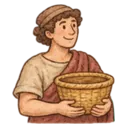
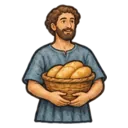
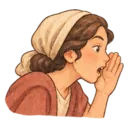
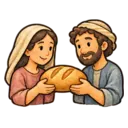
The imagined courtyard places the overlooked widows and their empty bowls beside a busy daily food distribution. The concerned conversation represents the Hellenists' complaint against the Hebrews. Clothing and faces do not mark a racial divide; the distinction is linguistic. The setting, individuals and gestures are artistic reconstruction, and the scene leaves the neglect unresolved as this verse does.
The Twelve and the listening disciples are imagined in a courtyard. Bread, bowls and serving tables illustrate the table service they discuss; the speaking and attentive listening evoke their responsibility to the word of God. The setting, clothing and faces are imaginative conventions, not documented likenesses. The image does not imply that serving people is unworthy.
This imagined courtyard gathering visualizes the instruction to seek seven trustworthy men full of the Spirit and wisdom. Their attentive faces and open hands suggest readiness; these qualities cannot be proven from appearance. The setting, gestures and unnamed speaker are artistic conventions. No completed appointment or visible form of the Spirit is shown.
This imaginative gathering expresses the verse's shared resolve through prayerful postures and a scroll suggesting the ministry of the word. The room, props, faces and exact arrangement are artistic conventions, not details specified by the verse or historical likenesses. The four men represent a group rather than an asserted total. Artwork remains pending human review.
The seven central men imaginatively represent those chosen by the assembly, with Stephen gently emphasized at the center. The surrounding community suggests the shared approval in Acts 6:5. Faces, ages, clothing, upward glances and the Jerusalem courtyard are artistic conventions, not details specified by this verse or verified likenesses. Stephen's peaceful bearing suggests faith; the Holy Spirit is not given a visible form.
The bowed men and the resting hands visualize men presented before the apostles and the laying on of hands after prayer. Faces, garments, courtyard and posture are imaginative details. The partial gathering does not claim to show everyone present or establish historical likenesses.
This imagined Jerusalem gathering represents the continuing spread of God's word and growth in disciples. The attentive linen-clad men stand for the many priests becoming obedient to the faith. The verse does not specify this meeting, its speaker, clothing, or architecture; these are illustrative conventions, not historical likenesses or archaeological certainty.
Stephen's humble gesture and the crowd's wonder imaginatively evoke his being full of grace and power while performing great wonders and signs among the people. The particular sign remains outside the picture because this verse names none. The faces, clothing, and courtyard are illustrative conventions, not historical likenesses or a documented setting.
Stephen faces questioning synagogue members, making the verse's disputation visible through speaking gestures and concentrated attention. The seven figures, their faces, garments and courtyard are imaginative choices, not historical likenesses or a claim about the number present. Their regional origins are not assigned to particular faces. The scene does not invent the debate's words or portray later violence.
The calm speaker and puzzled disputants imagine the contrast in Acts 6:10: his opponents could not withstand the wisdom and the Spirit by whom he spoke. Their poses suggest difficulty answering him, not conversion or physical defeat. The courtyard, clothing, faces and exact gestures are artistic choices; the Spirit is not given a visible form.
The whispered exchanges imagine the covert prompting behind the accusation. The courtyard, clothing, faces and gestures are artistic reconstruction, not historical likenesses. Stephen, Moses and God are not depicted; the scene does not present the alleged blasphemy as an actual event.
The seized man, conventionally identified as Stephen, represents the verse's 'him.' The gripping hands and movement toward seated elders connect seizure with being brought to the council; the crowd's gestures suggest the people, elders and scribes being stirred up. Faces, clothing, courtyard and council arrangement are imaginative, not verified historical likenesses or architecture. No later stoning is shown.
This imagined hearing places two speaking witnesses opposite the quiet accused man. Their gestures represent the false accusation, not proof that he opposed the holy place or the law. Faces, clothing, and chamber are artistic conventions; the verse does not specify them.
This imaginative hearing shows the accusation being spoken while Stephen listens. The gestures and attentive elders convey reported testimony, without treating the alleged destruction or change of customs as a visible event. Jesus and Moses are absent. Faces, garments and architecture are artistic conventions, not historical likenesses or archaeological certainty.
The seated elders' converging gazes visualize the council looking intently at Stephen. His peaceful expression and gently luminous face interpret the comparison to an angel's face. His upward gaze, appearance, clothing and the chamber are imaginative choices, not details specified by this verse or verified historical likenesses. Artwork remains pending human review.
 Ἑλληνιστῶν Hellenists
 Ἑβραίους Hebrews
 παρεθεωροῦντο being overlooked in the daily distribution
 καθημερινῇ daily