The foremost disciple imaginatively represents the request to learn prayer after Jesus finished praying. All three look toward Jesus outside the frame; no visible figure stands for Him. The olive tree, landscape, village and number of companions are artistic choices because the verse names neither the place nor the group size. John is mentioned in the request but is not depicted.
The disciples' prayerful postures imaginatively express Jesus' instruction to address the Father, honor His holy name, and seek His coming kingdom. Jesus remains outside the frame. The olive grove, three disciples, clothing, and warm afternoon light are artistic staging; the verse does not specify these details. God is not pictured.
The bread arranged for sharing pictures the prayer's shared need, while morning light suggests dependence renewed each day. The home, vessels and meal are imaginative details, not a particular meal narrated by the verse. God is not pictured.
The imagined neighbors and returned purse illustrate forgiving someone indebted to us. The older man's bowed head and open palm suggest prayer for God's forgiveness and for not being led into temptation. The verse gives no courtyard, purse, or particular neighbors; this is an illustrative composition, not a recorded event.
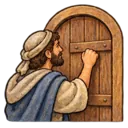
This imaginative scene pictures the midnight appeal in Jesus' example, with an unnamed caller addressing his unseen friend. The closed door, lamp, clothing and village are illustrative choices, not documented details. The requested three loaves are not shown as received; Jesus and His hearers remain outside the picture.
The host's welcome pictures friendship; the empty dish and basket picture his lack of anything to serve. The nighttime dwelling, clothes, staff, bundle and gestures are imaginative details, not details specified by this verse. The scene visualizes the situation the speaker describes, rather than the separate act of making his request, and leaves the need unmet. Neither man represents Jesus; the artwork claims no historical likeness.
This imagined lamplit interior connects the shut, barred door with the householder answering while still in bed beside his children. His raised palm conveys his refusal to be disturbed. The caller remains unseen; the two children, furnishings, clothing and architecture are illustrative choices, not details fixed by the verse. The householder is a character in Jesus' teaching, not a portrait of God.
This imaginative nighttime doorway scene gives concrete form to the friend rising and supplying what is needed. Bread and household details stage the saying rather than translate nouns in this verse. The completed exchange illustrates the result of persistent asking; the men's expressions cannot establish the inward motive. Neither figure represents Jesus or God.
This imagined visitor illustrates Jesus' commands to ask, seek, and knock: her open palm suggests asking, her approach along the path suggests seeking, and the partly open door reflects the promised opening. The verse states the promises; this domestic scene supplies no historical incident or named person. No visible figure represents Jesus or God.
The unnamed visitor at an opening door imagines the verse's third assurance: to the one knocking it will be opened. This is a teaching illustration, not a recorded visit. Asking/receiving and seeking/finding are parallel assurances explained in the verse note, not separate events pictured here. The person, clothing and architecture are imaginative conventions; neither Jesus nor God is depicted.
An imagined father and son illustrate the ordinary care assumed by Jesus' rhetorical question. The father offers the requested fish; the serpent is the rejected harmful alternative and is not pictured. Their faces, clothing and courtyard are artistic choices, not identified people or a recorded event. The human father does not represent God, and Jesus is not shown.
This imagined courtyard scene contrasts an egg offered to open hands with a scorpion resting separately on a stone. The scorpion represents the harmful substitute rejected by the rhetorical question; nobody offers it. The verse does not report this event, and the anonymous human hands do not depict Jesus or God.
This imagined household illustrates the earthly side of Jesus' comparison: a father gives bread as one example of a good gift to his children. The source calls the human givers evil despite their ability to give good gifts. The heavenly Father's greater promise is the Holy Spirit to those who ask Him. Bread does not represent the Spirit; God and the Spirit remain unpictured. This is an illustrative setting, not a recorded event.
This imaginative scene pictures the moment after Jesus drives out the mute demon: the man speaks and the crowd marvels. His open mouth and hands convey restored speech and relief. Jesus remains outside the frame; the demon is not pictured. Faces, clothing and the village courtyard are artistic choices, not details identified by the verse.
The imagined courtyard and three speakers give visible form to 'some of them said.' Their guarded expressions and outward gesture suggest an accusation directed toward Jesus beyond the frame. No demon or ruler is pictured, so the crowd's claim is not portrayed as fact. The people, clothing, and setting are artistic conventions, not historical likenesses or a known location.
The imagined questioners' raised finger and open palms express their testing demand for a sign from heaven. Jesus remains outside the frame, and the ordinary sky avoids inventing a sign being given. The faces, garments and village setting are artistic conventions, not historical identifications.
The handmade model imaginatively visualizes Jesus' saying: one kingdom breaks down within its own walls, and neighboring houses fall against one another. It illustrates the warning about internal division rather than depicting a historical collapse. Jesus' knowledge of their thoughts is not pictured.
The handmade miniature imaginatively illustrates Jesus' conditional question about a kingdom divided against itself. Its split gate and foundation picture internal division, not a literal view of Satan's realm or an event reported by Luke. Jesus challenges the accusation that he casts out demons by Beelzebul; he does not endorse it.
The imagined balance pictures Jesus' challenge to apply one standard: if His casting out demons were attributed to Beelzebul, how would His accusers explain their own sons casting them out? Their sons will be their judges. The scales and courtyard are an artistic metaphor, not objects or a setting specified by this verse; the stones do not represent equal spiritual powers.
This imagined courtyard illustrates Jesus' teaching, not a recorded staging of this saying. His hand is shown while He remains outside the frame; the relieved man and retreating violet wisps picture deliverance from demons. Sunlight reaching the hearers echoes the kingdom coming upon them. The wisps and lighting are artistic conventions, not a literal description of spirits or God's appearance.
This imagined courtyard gives concrete form to the saying: the armed man watches his own dwelling, while the orderly jars, sacks, cloth and chest represent his undisturbed possessions. His appearance, equipment and setting are imaginative conventions. The scene illustrates the comparison rather than a recorded encounter.
This imagined aftermath represents the saying through removed armor and plunder divided into three shares. The empty equipment suggests the former owner's defeat; the anonymous hand arranging a cup suggests the conqueror distributing the spoils. The room, objects, and number of shares are illustrative choices, not details supplied by the verse. Neither Jesus nor the unseen combat is portrayed.
This imagined harvest yard makes gathering and scattering visible as opposing actions around a common harvest. It illustrates Jesus' warning that a person not with Him is against Him and one not gathering with Him scatters. The verse names no crop or harvest incident; these workers and their setting are an analogy, and Jesus is not depicted.
The waterless valley follows the setting in the saying. The curling dust is an imaginative cue for the unclean spirit's restless search and intention to return, not a claim about its appearance. No literal house is shown: the spirit calls its former human dwelling its house. The image does not show a completed return.
The doorway view imagines the house as it is found: swept and orderly. The broom, arranged vessels, rolled mat and folded linens make those completed conditions visible. The spirit remains unseen. Furnishings and architecture are illustrative choices, not details specified by the verse; outward tidiness does not establish spiritual safety.
This imaginative dwelling gives visible form to the man's worsening condition. A narrow returning shadow and seven darker currents represent the returning spirit and its seven more wicked companions; these are visual conventions, not claims about spirits' appearance. The bowed man's posture suggests distress without depicting violence. The setting and furnishings are imagined, and this does not portray a recorded encounter or Jesus.
The speaking woman and gathered listeners picture her raised voice addressing Jesus, who remains outside the frame. Her blessing concerns the womb that bore Him and the breasts at which He nursed; His mother and infancy are not staged as present. The courtyard, clothing, faces and hand gesture are imaginative details rather than details specified by the verse.
The anonymous listeners and the woman's hand over her heart imaginatively connect hearing God's word with cherishing and obeying it. Their setting and gestures are illustrative choices, not details supplied by Luke 11:28. Jesus is kept outside the image; no visible person represents Him or God.
The imagined village gathering relates the crowd's questioning hand and doubtful expressions to its demand for a sign and Jesus' sober rebuke. Jesus remains outside the frame. No miraculous sign is shown. Jonah is mentioned in the saying, not placed among these listeners. The clothing, setting, gestures, and individual faces are imaginative choices; the image does not itself explain what the sign of Jonah means.
These imagined first-century listeners represent "this generation," turning toward Jesus beyond the picture. Their reflective faces invite attention to His claim. Jonah and the Ninevites belong to His comparison, not to this gathering, so neither appears. The village, people, and expressions are imaginative conventions; the image does not claim that everyone believed or repented.
This imagined courtyard shows anonymous listeners facing the challenge of Jesus' saying, with Jesus outside the picture. The winding road recalls the queen's long journey to hear wisdom; the men's reflective and guarded postures invite consideration of their response to One greater than Solomon. The queen, Solomon, and the future judgment are not depicted. The setting and appearances are imaginative, not historical identifications.
An imagined view of Ninevite repentance illustrates why Jesus says those men will condemn this generation at judgment. The men's poses and city architecture are artistic conventions, not details specified in Luke. Jonah, Jesus and the future judgment remain unseen; the full saying declares that One greater than Jonah is here.
This imagined household illustrates the saying: the lit lamp is raised openly, and the basket stands apart rather than covering it. The anonymous adults entering show the purpose of making the light visible. The room, people and furnishings are illustrative choices, not a recorded visit or a verified historical reconstruction. Jesus is not depicted.
This imaginative scene pairs an attentive eye with a lamp lighting the woman's clothed figure, recalling Jesus' saying that the eye is the body's lamp. The shadowed room recalls His warning that an evil eye leaves the body dark. The woman and setting are illustrative, not an event identified by the verse; the picture does not equate physical sight or skin color with righteousness.
This imaginative still life is not an event narrated in Luke 11:35. The lamp's bright reflected surface and dark, unlit interior picture the warning that what seems to be light within may be darkness. The examining hand suggests taking heed; the courtyard sunlight is ordinary light, not a portrayal of God.
The unnamed woman and domestic room are imaginative choices for the lamp comparison, not an episode narrated in the verse. Light reaching her face, hands, garments and feet illustrates whole-body illumination; the painting uses physical lamplight as an analogy rather than depicting a supernatural bodily glow.
The host's open hand evokes the Pharisee's invitation. The low view beside the foreground cushion suggests the guest's place after Jesus entered and reclined; Jesus remains outside the image. The room, clothing, courtyard and meal details are imaginative, not details specified by the verse.
The unused washing vessels beside the meal imaginatively connect the expected washing with the Pharisee's surprise. His glance is directed toward Jesus beyond the frame. The room, clothing and objects are illustrative choices, not details specified by the verse.
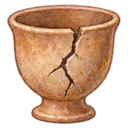
This imaginative still life uses clean outer clay and stained interiors to echo the Lord's contrast between outward cleansing and inward corruption. The coins suggest plundering and ill-gotten gain; the verse does not say coins were in the vessels. The anonymous hands illustrate surface cleaning, not Jesus. This is a teaching composition, not a reconstruction of a witnessed act.
This imagined household still life uses the cup's continuous inner and outer clay surfaces to make outside and inside visible together. The dark interior marks suggest inward neglect beneath a cared-for exterior. The analogy points to the Maker's authority over both outward and inward life; it is not an event described in Luke 11:40. God is not pictured.
Sharing bread from a bowl gives visible form to the command to give what is within as alms. The open bowl connects its contents with the gift; the clean vessels quietly echo the verse's declaration of cleanness. The anonymous hands, food and household setting are imaginative teaching choices.
This imagined courtyard contrasts careful herb portions with an unattended balance and an overlooked neighbor, evoking neglected justice and love. The neighbor, loaf, and setting are teaching devices, not events reported in this verse. Jesus remains outside the image. His warning calls for justice and the love of God without neglecting tithes.
The empty front seat and a man enjoying marketplace greetings imaginatively pair the two forms of public honor Jesus rebukes. The scene illustrates the saying rather than documenting a particular event; the people and architecture are artistic conventions. Jesus is outside the image.
This imagined visualization of Jesus' comparison uses a viewer-only earth cutaway to reveal graves beneath an ordinary, unmarked path. The anonymous travelers walk above them unaware. The landscape and burial architecture are illustrative conventions. The concealed graves emphasize the sober warning about hidden danger. Jesus remains outside the picture.
The scholar's hand on his chest and open gesture toward his companions visualize 'us also' in his protest. Jesus stays outside the frame. The faces, garments, companions, study objects, and room are imaginative details, not historical likenesses or details specified by this verse. The scene depicts the speaker's complaint without endorsing it.
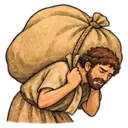
An imaginative teaching vignette makes the difficult burdens visible as heavy sacks, while the seated men's inactive hands picture the law experts' refusal to help. Luke records Jesus' rebuke, not a literal sack-carrying incident. Jesus is outside the image; the people and courtyard are illustrative conventions.
The unfinished memorial and tools picture building the prophets' tombs; the sealed burial doorway recalls their deaths without showing violence. This imagined setting illustrates Jesus' rebuke, not a recorded visit to a particular tomb or an archaeological reconstruction. The ancestors and prophets are absent; the ancestors' killing of the prophets remains explicit in the verse.
This imagined tomb-building scene connects the fresh masonry and the patron's consenting gesture with Jesus' charge: their fathers killed, and they build. The anonymous men illustrate that relationship, not identified participants in a recorded building event. The earlier killing remains offstage; the careful stonework does not undo the complicity Jesus names. Faces, clothing and architecture are artistic conventions.
This imaginative still life is not a recorded incident. Scrolls, travel gear and intact staffs suggest the sending of prophets and apostles. The broken staff and abandoned cloak allude to messengers killed, while the closed gate suggests persecution. These objects are visual metaphors, not details supplied by Luke 11:49. God and Jesus are not pictured.
This imagined still life uses scrolls for the prophets' witness, crimson cord for their shed blood, and the weighted scale for the accountability required of this generation. The anonymous feet evoke those addressed. These are explanatory visual metaphors, not objects or an event specified by Luke 11:50.
This imagined, unpeopled forecourt focuses on the space between the altar and the sanctuary where the verse says Zechariah perished. The muted reddish trace recalls bloodshed without depicting a killing. It does not show Abel and Zechariah together or reconstruct a recorded moment; the architecture is illustrative. Jesus' warning that this generation will be held to account remains the verse's meaning.
This imaginative tableau gives the saying's key-and-entry imagery a visible form: teachers remain outside a doorway and obstruct seekers while one holds the key away from use. The verse concerns access to knowledge, not a reported incident at a physical door. The people, architecture, scrolls, and sunlight are artistic conventions; Jesus is not shown. The warm room suggests the value of the knowledge being withheld.
The five questioners lean out of an imagined house doorway, their tense faces and overlapping gestures picturing fierce verbal pressure and questions about many matters. Their attention reaches toward Jesus beyond the frame as He departs; He is not pictured. The number of men, faces, clothing, architecture and daylight are artistic choices, not details specified by the verse.
Their shared gaze toward Jesus outside the frame and their guarded expressions imagine the verse's hostile watchfulness and attempt to catch His words. The questioning hand suggests verbal entrapment, not physical capture. The three figures, gestures, clothing, courtyard, and pottery are imaginative choices; the verse does not specify those details. Jesus is not depicted.